
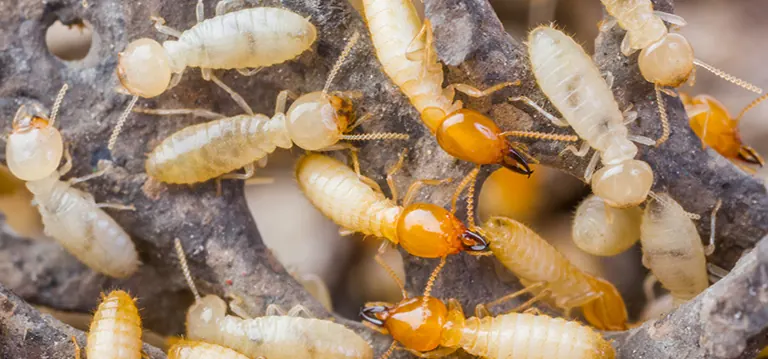
In Moreleta Park the termite call we get most is about the lawn, not the house. Harvester termites love the big, sunny kikuyu lawns of the suburb's freestanding homes, and a dry winter is when they do their damage. The rarer but more serious call is about subterranean termites working inside a wall or cupboard. We treat both, and the first visit is about working out which one you're dealing with.
Lawn or house? Reading the signs
Harvester termites
- Patches of grass that thin out and then go bare, usually in the driest months
- Small round openings in the soil with loose, crumbly soil around them
- Short cut pieces of grass lying near the holes
- Workers out on the surface late in the afternoon or on cloudy days
These termites eat grass and dry plant material. They don't attack the house, but they can take a lawn back to bare soil in one season if left alone.
Subterranean termites
- Brown mud tubes on foundation walls, inside cupboards or along skirting
- Door frames or skirting that sound hollow when tapped
- Paint that blisters over a soft patch
- Winged termites emerging from a crack indoors after the first storm
These are the ones that damage timber. Anything made of cellulose is food, from roof trusses to stored cardboard.
Why Moreleta Park homes are exposed
Many houses here have had decades of garden built up around them. Flowerbeds get raised, paving gets added, a lapa or an extra room goes on, and each change can break whatever soil treatment was applied when the house was built. Termites find the gap. Homes in the newer estates on the edge of the suburb face a different pressure: their gardens were cut out of ground that termite colonies already occupied, and those colonies don't move out just because a house went up.
In the townhouse complexes, the risk often lies in the shared garden. A harvester termite colony under a common lawn will spread to every unit's patch of grass, and it makes sense to treat it as one job.
How we deal with termites
- Inspection and identification. We check the lawn, the foundations, the roof void, cupboards, frames and any timber in contact with soil.
- Tracing the route. Expansion joints, pipe entries, cracks in slabs and soil piled against walls are where we look first.
- The right treatment. Harvester termite nests are treated at their active openings so the colony carries the product down. Subterranean termites get a registered soil treatment around and under the structure, or baiting where drilling isn't practical.
- Follow-up. On heavier infestations we come back to make sure the tubes stay dead and the holes in the lawn stay closed.
The thing people get wrong
With lawn damage, people often reach for fertiliser, top dressing and new runners. It's the natural instinct, but if the colony is still active the new grass gets harvested just like the old. Treat the termites first, give it time, then repair the lawn. With subterranean termites, the mistake is breaking the mud tubes and spraying what you can see. The colony underground loses almost nothing, and it reroutes somewhere hidden.
Keeping termites out
- Keep beds and mulch below the damp-proof course and away from the walls.
- Don't let a dripping garden tap or a leaking gutter keep one patch of soil wet against the house.
- Clear out old timber, offcuts and boxes stacked against walls or on the garage floor.
- If you're adding a room, a lapa or new paving, ask about a soil treatment before the slab goes down.
A local tip: watering hard in late winter, when the rest of Pretoria East is brown, helps a lawn recover from harvester termites but doesn't drive them off. Use it after treatment, not instead of it.
What does it cost?
A harvester termite treatment on an ordinary garden is a modest job, priced on the area involved. Structural work costs more, and depends on the perimeter, whether we need to drill through paving or a slab, how much timber is affected and whether baiting suits the site better. We quote after inspecting, never blind. A single termite hole in the lawn can sometimes be handled with a product from a garden centre, and we'll be honest if that is all you need.
For the bigger picture, see termite control across Pretoria, or everything we treat in Moreleta Park. If the lawn is also lifting in ridges, that may be moles rather than termites, so take a look at mole control in Moreleta Park. Flying ants that turn out not to be termites are covered on our local ant page, and next door we handle plenty of termite jobs in Faerie Glen.
We're SAPCA registered with 25 years behind us, and our termite treatments carry a 3-month guarantee: if activity returns in that time, we return. Phone 012 012 5526, or WhatsApp us a photo of the tubes or the lawn.
Questions we get asked
Why is my Moreleta Park lawn worst in winter?
Because harvester termites forage hardest when the grass is dry. Winter is the dry season on the Highveld, so the damage shows up between May and the first rains.
Will harvester termites spread into my house?
No. They only eat grass and plant material. It's subterranean termites that damage timber in buildings, and they're a separate species.
My house was treated when it was built. Is it still protected?
Probably not fully. Soil treatments wear down over the years, and extensions, paving and new flowerbeds can break the treated zone.
Can you treat the shared lawn in our complex?
Yes. A colony under a common lawn affects every unit, so we can treat it as one job with the body corporate.
Should I break open the mud tubes I've found?
No. Leave them as they are. They show us the route the termites use, and breaking them only makes the colony build somewhere harder to find.
How long before my lawn recovers?
Once the colony stops foraging, grass usually starts coming back with the summer rain. Hold off on reseeding until the holes stop reopening.