
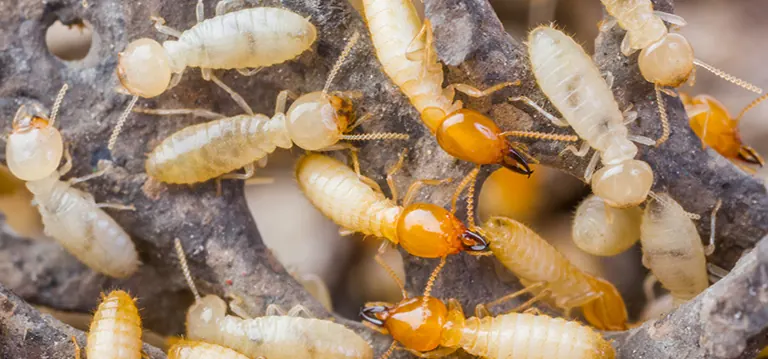
If you've found mud tubes, hollow-sounding skirting boards or a swarm of winged termites indoors, you need an inspection before you need a spray. Pretoria has two very different termite problems, and treating the wrong one wastes money: subterranean termites that eat timber in the house, and harvester termites that strip the lawn. We've been treating both across Pretoria and Centurion for 25 years, and the first job is always to work out which one you have.
The two termites Pretoria homeowners deal with
Subterranean termites: the ones that damage houses
These live in the soil and travel to food through sealed mud tunnels, because they dry out and die in open air. They eat anything made of cellulose: roof timbers, door frames, skirting, built-in cupboards, cardboard boxes in the garage, even the paper on drywall. You rarely see the termites themselves. What you see is the evidence: thin brown mud tubes running up a foundation wall or inside a cupboard, timber that sounds papery when you knock on it, or paint that bubbles where they've tunnelled underneath.
Older homes in the Moot, Brooklyn and Waterkloof, with timber floors and decades of garden around the foundations, are classic targets. New builds aren't immune either. A pre-construction soil treatment wears off over the years, and paving, extensions and new flowerbeds can open fresh routes in.
Harvester termites: the ones that wreck lawns
Harvester termites don't touch your house. They cut grass and carry it underground, and in a dry Highveld winter they can turn a kikuyu lawn into bare, sandy patches surprisingly quickly. Look for small round holes in the soil, loose soil dumps around them, and short, cut pieces of grass. You'll often see the workers out foraging on overcast days or late in the afternoon. This is one of the most common termite calls we get from Pretoria East and Centurion gardens, and it's treated completely differently from a structural infestation.
Why the first summer rain matters
After the first proper thunderstorm of the season, mature colonies release winged reproductives, the flying ants that pour out of the ground and gather around lights in the evening. A swarm on its own doesn't mean your house is infested. But if the swarm comes out of a wall, a door frame or a crack in the floor indoors, there's an active colony using your building, and that needs looking at soon.
How we treat termites
- Inspection. We check foundations, walls, roof void, cupboards, door and window frames and the garden for tubes, damage and soil activity, and confirm the species.
- Finding the route in. Expansion joints, cracks in slabs, pipes through walls, wood touching soil and flowerbeds piled against the house are the usual entry points.
- Treatment matched to the termite. For subterranean termites we use registered soil treatments to create a treated zone around and under the structure, and baiting where drilling or trenching isn't practical. For harvester termites we treat the active nest openings in the lawn so the colony takes the product underground.
- Follow-up. Termite work isn't a one-visit job if activity was heavy. We come back to check that the tubes stay dead and the lawn holes stop reopening.
What people get wrong
The most common mistake is breaking open the mud tubes and spraying the termites you can see with a can from the supermarket. It kills a few dozen workers, the colony underground loses nothing, and the termites simply build around the problem somewhere you can't see. Leave the tubes alone and call us. They're also exactly what we use to trace the activity back to where it enters the building.
The second mistake is assuming a house that was treated when it was built is still protected. Soil treatments don't last forever, and renovations disturb them.
Prevention that actually helps on the Highveld
- Keep soil and mulch below the level of the damp-proof course and away from the walls. Raised flowerbeds against a house are one of the most common ways in.
- Don't store firewood, old timber or boxes against outside walls or on the garage floor.
- Fix leaking taps, gutters and irrigation that keep the same patch of soil wet against the foundations.
- In winter, water the lawn when you can. Harvester termites do the most damage to dry, stressed grass.
- Have the house checked before you buy, and after any major building work.
What does termite control cost?
It depends on the termite and the size of the job. A harvester termite treatment on a normal garden is a fairly modest job. Treating a house for subterranean termites costs more, and the price depends on the length of the perimeter, whether we need to drill through paving or slabs, how much timber is affected, and whether baiting is the better route. We'll give you a clear quote after the inspection. We won't quote a structural termite job blind over the phone, because nobody can do that honestly.
Homes, estates and commercial sites
We treat freestanding homes, complexes and security estates, where we can work with the body corporate on a block or whole-estate plan, and commercial buildings that need a termite inspection as part of a regular service. If you're dealing with something else that looks like termites but isn't, our ant control in Pretoria covers the ant species that often get confused with them.
Termite pressure is strong right across the city. We do a lot of termite work in Centurion, where many homes and complexes back onto open veld, and in the older gardens covered by our Waterkloof termite treatments. If you're in Pretoria East, see termite control in Moreleta Park.
We're SAPCA registered, and our treatments carry a 3-month guarantee: if the activity comes back in that time, so do we. Seen mud tubes, a damaged lawn or flying ants coming out of a wall? Call us on 012 012 5526, or WhatsApp us a photo and we'll tell you what you're looking at.
Questions we get asked
Are flying ants after the rain a sign my house has termites?
Not on their own. Swarms after the first summer storm are normal across Pretoria. It's only a warning sign if they're coming out of walls, floors or door frames inside the house.
Do harvester termites damage houses?
No. Harvester termites only eat grass and plant material, so the damage is to your lawn. Subterranean termites are the ones that attack timber in buildings.
Can I treat termites myself?
For a single harvester termite hole in the lawn, sometimes, yes. For subterranean termites in a building, no. Surface sprays don't reach the colony, and disturbing the tubes makes the activity harder to trace.
Do we have to move out during termite treatment?
No. Termite treatments are applied to the soil and to specific points around the structure, so you can stay at home. Keep children and pets away from treated areas until they're dry.
How do I know the treatment worked?
The mud tubes stay dry and broken, no new ones appear, and in a lawn the holes stop reopening. We check this on the follow-up visit.
Should I get a termite inspection before buying a house in Pretoria?
Yes, especially for older homes with timber floors or roofs. It costs far less than repairing damaged roof trusses or built-in cupboards after you've moved in.