
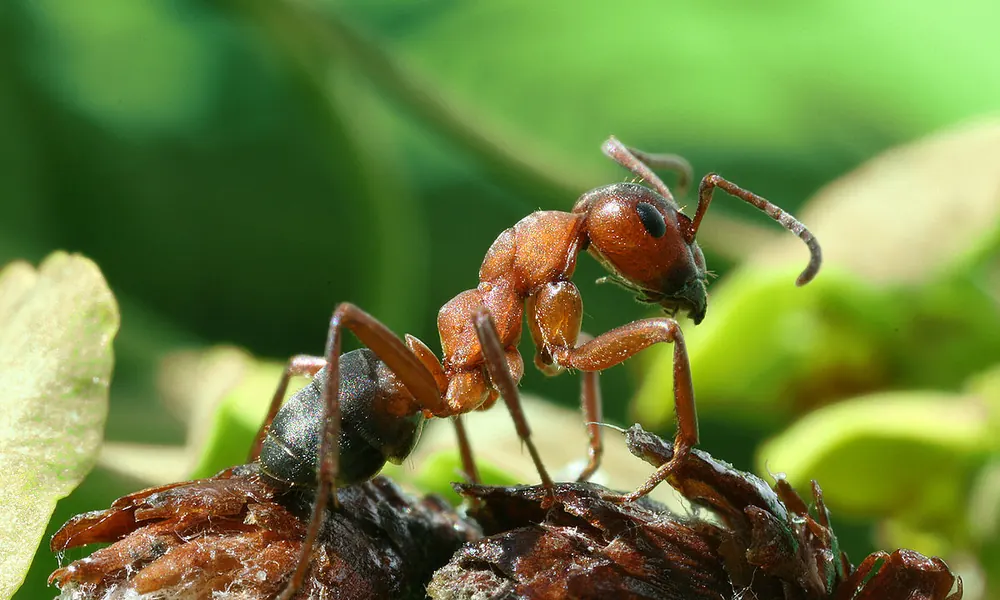
To get rid of ants properly, you need to kill the colony, and the way to do that is with bait the workers carry home to the queen. Spraying the trail you can see only kills the foragers, and the nest sends out more. We've been dealing with ants in Pretoria and Centurion homes, gardens, estates and businesses for 25 years, and the calls follow the weather closely: they spike as the first summer storms build, and again whenever a hot, dry spell sends colonies looking for water.
Why ants come inside before it rains
Many Pretoria residents notice that ants suddenly flood into the kitchen a day or two before a thunderstorm. It's not your imagination. As the pressure changes and the soil gets ready to flood, colonies move eggs and larvae to higher, drier ground, and forage hard for food. A house with a sugar bowl on the counter and gaps in the skirting is the obvious target. Long dry spells have the opposite effect: ants come in looking for water, around sinks, bathrooms and pot plants.
The ants we see most around Pretoria
Small brown or black house ants
These are the tiny ants that appear in long lines across counters and floors, often coming out from under skirting boards, plug points or tile grout. Colonies can be under paving, in wall cavities or in garden beds right against the house, and some species run several nests connected together, which is why they seem to come from everywhere at once.
Ants that build heaps in the lawn
Pugnacious ants and similar species build nests in lawns and garden beds, leaving loose soil heaps and bare patches. They can bite, they farm aphids and scale on plants, and big colonies can spoil a lawn. They're often confused with harvester termites, which also leave holes and soil in the grass.
Flying ants: are they ants at all?
The winged swarms after the first big storm are usually termites, not ants. Ants have a pinched waist and back wings shorter than the front ones. Termites have a straight, thick waist and four equal wings that drop off quickly. If you're finding piles of discarded wings indoors, read about termite control across Pretoria before treating for ants.
Signs it's more than a few ants
- Trails that come back the same day after you've wiped them away
- Fine soil or sand pushed out of tile grout, skirting gaps or paving joints
- Ants inside electrical plug points or around the geyser
- Aphids and sooty mould on garden plants with ants running up and down the stems
- Soil heaps in the lawn that keep reappearing after you rake them flat
How we treat ants
We start by following the trails back. Ants are very consistent, so a trail that goes behind a cupboard, along the outside wall and under a paving slab usually leads to the nest. Then we use the right bait for the species: some prefer sugary baits, others protein or oils, and the wrong bait gets ignored. Workers carry it back and share it through the colony, including the queen. Outside, we can add an odourless, non-staining barrier treatment around the foundations and entry points to stop new ants coming in. For lawn nests, we treat the nest directly.
Baiting takes a few days to work, and it's normal to see more ants at first while they feed. That's a good sign, not a failed treatment.
What people often get wrong
The natural reaction to an ant trail is to spray it, or wipe it with bleach. Either way, you kill a few hundred foragers, break the scent trail, and the colony simply sends workers out along a new route. Worse, some species split into several new colonies when they're stressed, so a spray can turn one nest into three. Leave baited trails alone for a few days.
A Highveld tip for spring
Before the first storms in October, check where your paving meets the walls of the house. Ants often nest under the paving and come in through the expansion gap. Trim plants and creepers back so they don't touch the walls or windows, and move pot plants a little away from the house. Branches and leaves touching the building are an ant bridge straight inside.
Homes, estates and businesses
For homes, a single targeted treatment is usually enough, with a check afterwards. Estates and complexes with shared paving and gardens benefit from treating several units at once, because ant colonies spread under boundary walls. Restaurants, food factories and schools need ants kept out of kitchens and food areas entirely, which is a job for scheduled monitoring and baiting. The broader group of insects we treat is covered on our page about crawling insect control in Pretoria.
What does ant control cost?
It depends on the size of the property, how many colonies are involved, whether they're inside the walls, under paving or in the lawn, and whether a barrier treatment is needed. A single nest feeding into one kitchen is a quick job. Lawn ants across a large garden, or several connected colonies in a complex, take more time. If you have a small trail and can find the nest, a bait from the shop placed on the trail can do the job, and we'll tell you if that's all you need.
Pretoria East gets plenty of ant calls, especially around the newer complexes. See ant treatments in Garsfontein and ant control near the Faerie Glen reserve. Families in Elardus Park can find their local page too.
We're SAPCA registered, and if the ants we treated come back within three months, so do we, under our guarantee. Call 012 012 5526, or WhatsApp us a close-up photo of the ants and we'll identify them for you.
Questions we get asked
Why are there suddenly ants everywhere before a storm?
Colonies move eggs and larvae to drier ground and forage hard before heavy rain, so they often come indoors in large numbers a day or two before a thunderstorm.
Why does the treatment seem to bring more ants at first?
That's the bait working. Workers gather to feed on it and carry it back to the nest, so activity often rises for a few days before it drops sharply.
How do I tell flying ants from flying termites?
Ants have a pinched waist and front wings longer than the back ones. Termites have a thick, straight waist and four wings of equal length that break off easily.
Can ants damage my house?
Most ants don't damage structures, but some nest in wall cavities and push soil out through gaps, and ants inside plug points can affect electrical fittings.
Should I wipe ant trails with bleach or vinegar?
Not if you're baiting. Cleaning breaks the scent trail the ants need to find the bait and carry it back to the nest, so leave baited trails alone for a few days.
Do ants in the lawn need treatment?
Only if they're a problem. Small colonies are harmless, but large nests that bite, spoil the lawn or farm aphids on your plants are worth treating at the nest.