
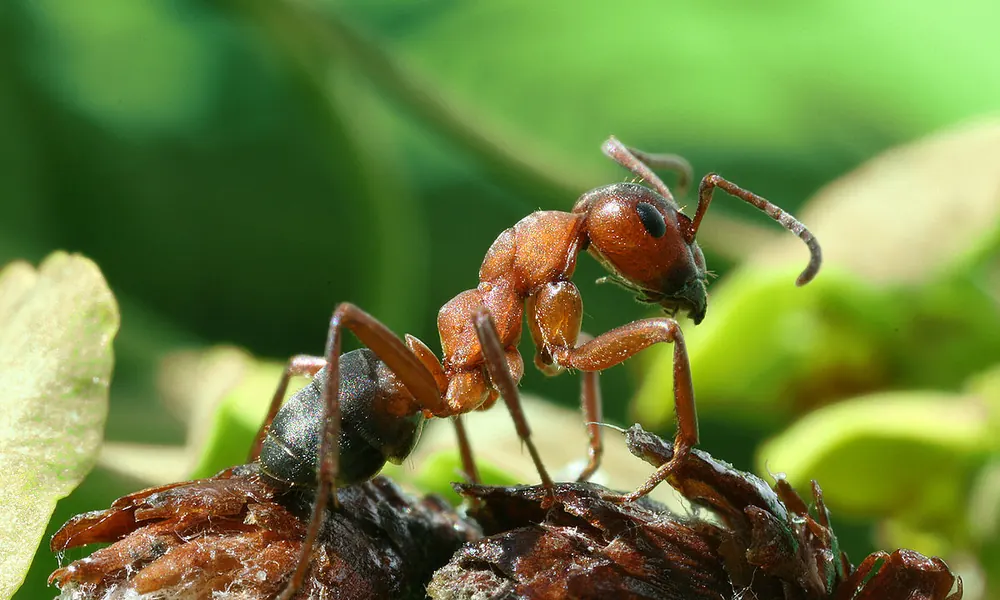
The fastest way to get rid of ants in a Moreleta Park home is to treat the nest, not the trail you can see. Wiping or spraying the line on the counter kills the foragers, but the colony outside simply sends more. We use baits that worker ants carry back to the nest, plus targeted treatment where the ants enter the building.
Why ants are such a regular complaint here
Much of Moreleta Park has paved driveways, patios and walkways laid over sandy soil, and ants love the space underneath. Colonies nest under paving bricks, along the edges of slabs and at the base of retaining walls, pushing up little heaps of fine sand between the joints. From there, the foragers follow the line of a wall, a pipe or an electrical cable into the house.
The pattern is seasonal. Before a thunderstorm, when the air turns heavy and humid, colonies often move indoors or send out big foraging parties. In dry spells, they come in looking for water around sinks, pet bowls and the bathroom. Spring and the start of summer are the busiest time for ant calls in the suburb. Townhouse complexes get their share too, because ants nesting under a shared garden or a communal paved area will happily forage into several units at once.
Ants we commonly see
- Small brown or black house ants that trail along skirting boards and counters to sweet or greasy food.
- Ants nesting under paving that push up sand between bricks and around the pool coping.
- Larger ants in the garden that farm aphids and scale on plants, protecting the pests in return for their sugary secretions.
Ant or termite?
After the first summer rain, flying insects pour out of the ground across Pretoria East. Some are flying ants, many are termites. Ants have a pinched, narrow waist and elbowed antennae; their front wings are noticeably longer than the back ones. Termites have a thick, straight body, straight antennae and wings that are all the same length. If they're coming out of a wall or floor inside the house, get it looked at. Our Moreleta Park termite service covers what to do then.
Our process
- Follow the trail. We trace the ants back from the kitchen to where they enter, and then outside to the nest if we can find it.
- Bait placement. Ant baits go along the active trails and near entry points. Workers take the bait back and feed it to the colony, including the queen.
- Targeted perimeter treatment. Where it's needed, we apply an odourless, non-staining residual product at entry points and along the base of outside walls.
- Check-back. Ant activity usually tails off over several days rather than stopping instantly. If it doesn't, we come back.
The most common mistake
Spraying the trail as soon as the bait is down. Ants need a few days to carry the bait back to the nest, and spraying kills the very workers doing the job. It can also split a colony into several smaller ones, which is how one ant problem becomes three. Leave the trail alone after baiting, even though it's tempting.
Prevention
- Store sugar, honey, syrup and pet food in sealed containers.
- Rinse cooldrink cans and bottles before they go in the recycling bin.
- Seal gaps along skirting boards and where pipes enter walls.
- Trim plants and shrubs that touch the house wall; ants use them as bridges.
A Moreleta Park tip: if you've got ants coming up through the paving next to the house, check whether the joints were filled with loose sand that's washed out. Refilling with a firmer jointing compound along the wall line makes it much harder for colonies to nest right at the foundation.
What does it cost?
A standard ant treatment for a house or townhouse is one of the smaller jobs we do. The cost goes up with the size of the property, the number of colonies and whether ants are also nesting in walls or roof spaces. For one trail to the sugar bowl, a good ant bait from the supermarket placed on the trail and left alone often does the trick. If that hasn't worked within a week or two, call us.
For other pests in the suburb, see our Moreleta Park services. For ant control in the rest of the city, there's ant treatment across Pretoria, and we're regularly in Faerie Glen for ant problems as well.
With 25 years in the job and SAPCA registration, we stand behind our work: if the ants are back within three months, so are we. Call 012 012 5526, or WhatsApp us a photo of the ants or the trail.
Questions we get asked
Why do the ants arrive just before a thunderstorm?
Rising humidity and heavy air before a storm prompt many colonies to move or forage more widely, and your house offers food and a dry spot.
Why are there little heaps of sand between my paving bricks?
That's usually an ant colony nesting under the paving. Worker ants carry out sand as they dig.
How long does ant bait take to work?
Usually a few days to a week. You may see more ants at first as they feed on the bait, which is a good sign.
Are ant baits safe with pets around?
We place baits in spots pets can't easily reach and use only small amounts. Let us know about your animals and we'll plan around them.
How can I tell flying ants from flying termites?
Ants have a narrow waist and front wings longer than the back wings. Termites have a straight, thick body and four equal wings.
Do ants damage the house?
Most house ants don't, though nests under paving can loosen bricks. Carpenter-type ants in damp wood are rarer and worth getting checked.