
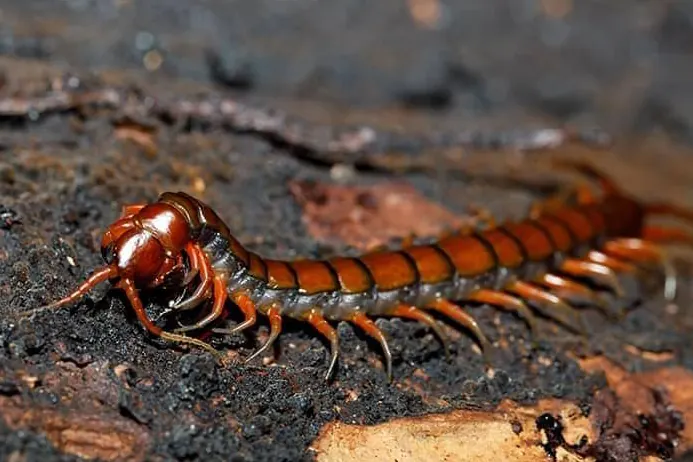
Centipedes indoors are a sign, not the whole problem. They're hunters, and they come into a house because it offers moisture and something to eat: crickets, cockroaches, fishmoths, spiders and small insects. Get rid of the damp corners and the insects, treat the gaps they use, and centipede numbers drop. That's the approach we take in homes across Pretoria and Centurion.
Which centipedes turn up in Pretoria homes?
Most calls involve one of two types.
Large garden centipedes
These are the flat, many-segmented ones with a pair of legs on each segment, sometimes as long as a finger or more. They live under rocks, paving, logs, compost and leaf litter, and come indoors at night, usually at ground level through gaps under doors, drains and air bricks. They can give a painful bite, so don't pick one up. A bite usually means pain and swelling for a while, but if someone has a strong reaction, or a small child is bitten, get medical advice.
House centipedes
These have very long, fine legs and move incredibly fast. They prefer bathrooms, basements, store rooms and other damp spots inside the house and can live indoors for long periods if there's enough to eat. They look alarming but aren't the ones that cause real trouble.
Centipede or millipede?
People mix these up all the time, and it matters because the fix is different.
- Centipedes are flat, fast and have one pair of legs per body segment. They hunt and can bite.
- Millipedes (the shongololos everyone knows) are rounded, slow and have two pairs of legs per segment. They eat rotting plant material, curl up when disturbed and don't bite.
If you've got hundreds of slow, curling creatures on the walls after rain, you have millipedes, and our millipede control in Pretoria covers that.
Why the Highveld suits them
Pretoria's dry winters actually work in our favour: centipedes need moisture, and they struggle in dry, exposed ground. In summer it's a different story. Afternoon thunderstorms soak the gardens, leaf litter and compost stay damp, and insect numbers shoot up. Centipedes thrive and, when heavy rain floods their hiding places, they move to drier shelter, which is often your house. Rocky gardens on the ridges and older properties with deep leaf litter under mature trees see the most.
Signs you have more than the odd one
- Seeing centipedes indoors several times a week, not once a season
- Finding them in the same rooms, usually bathrooms, the kitchen, the laundry or the garage
- Lots of crickets, cockroaches or fishmoths in the house as well
- Damp skirting, a leaking geyser overflow or a wet patch outside that never dries
What we do
We start with an inspection, inside and out, looking for moisture and harbourage. That means checking under sinks, around geysers and drains, along the foundations, behind stacked items in the garage and in the garden beds against the house. We'll point out the damp problems we find, because no treatment holds up well if the moisture stays.
Then we treat. Outside, an odourless residual barrier around the foundations, door thresholds, air bricks and the edges of paving stops centipedes crossing into the house. Inside, we treat skirting, the edges of bathrooms and kitchens, and the voids behind appliances where they shelter. Because the treatment also deals with the crickets and cockroaches they hunt, it removes their reason for coming in. Normal life carries on; keep kids and pets off treated surfaces until they're dry.
If the insect population behind the centipedes is significant, we'll include it properly rather than as an afterthought. Our crawling insect control covers cockroaches, crickets and fishmoths in the same visit.
The common mistake
Killing every centipede you see and leaving the damp alone. A wet laundry, a constantly dripping outside tap or a bathroom with poor ventilation will keep pulling them in. The other mistake is piling thick mulch right up against the walls. It looks neat and saves water, but it creates a damp, insect-rich strip exactly where centipedes need it most.
Prevention that works here
- Fix leaks under sinks and around geysers, and make sure the geyser overflow drains away from the house.
- Keep a dry, clear strip of about a hand-span between garden beds and the walls. Gravel works well.
- Fit brush strips under outside doors and cover drains and floor traps.
- Store items in the garage on shelves, not on the floor.
- Move irrigation sprayers so they don't soak the foundations every evening in summer.
What does centipede control cost?
For most homes it's a single, straightforward treatment, priced on the size of the house and the length of the perimeter. Larger rocky stands, properties with outbuildings, or homes with a big underlying insect problem take more work. If you see one centipede every few months, fixing a leak and fitting a door seal may be all you need. We'll say so if that's the case.
Homes, complexes and businesses
Ground-floor units in complexes often get centipedes from shared garden areas, so a block-wide perimeter treatment arranged through the body corporate gives better results. Schools, offices and warehouses with damp store rooms can have it included in a scheduled service. We treat centipedes right across the city, including centipede problems in Garsfontein and Centurion homes with centipedes.
We're SAPCA registered and have been doing this for 25 years. Our 3-month guarantee means that if centipedes come back within three months of treatment, we return. Call 012 012 5526, or WhatsApp us a photo so we can confirm what it is.
Questions we get asked
Do centipedes in Pretoria bite?
Yes, the larger garden centipedes can bite, and it's painful. Don't handle them. If a child is bitten or someone reacts strongly, get medical advice.
Why are centipedes coming into my house after rain?
Heavy rain floods the soil, rocks and leaf litter where they live, so they look for drier shelter. Gaps under doors and around drains lead them straight inside.
Does killing the insects in my house help with centipedes?
Yes. Centipedes come in to hunt, so fewer crickets, cockroaches and fishmoths means fewer centipedes.
Are house centipedes dangerous?
Not really. The long-legged house centipede is fast and alarming to look at, but it's not the one that causes problems. The big garden centipedes are the ones to avoid touching.
Do I need to move out for centipede treatment?
No. It's a residual treatment around the outside and along skirting inside. Keep children and pets off treated surfaces until they've dried.
How do I stop centipedes coming up the shower drain?
Keep drain covers in place and fix any damp areas around the bathroom. A perimeter treatment outside also stops them reaching the house in the first place.