
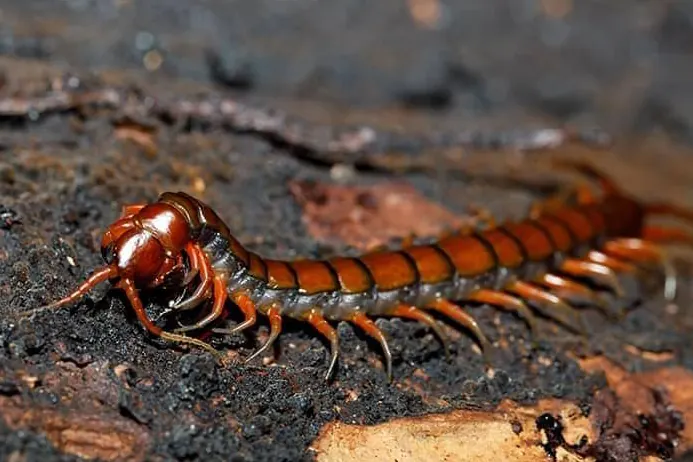
A centipede in the house is a sign of damp somewhere close by. Centipedes live outdoors under pots, mulch, stones and leaf litter, where moisture keeps them from drying out, and they hunt small insects at night. After a summer storm, or when an irrigation system keeps one bed permanently wet, they move towards the house and come in under doors, through drains and through gaps around pipes. Dealing with that damp edge, and treating it, is the answer.
Centipede or millipede?
People mix them up all the time. Centipedes are flat, fast, and have one pair of legs per body segment, with long legs that stick out to the sides. They're hunters and can bite. Millipedes, the shongololos, are round, slow, curl up when disturbed and have two pairs of legs per segment. They eat rotting plant material and don't bite. If what you're seeing is slow and curls into a spiral, our page on millipedes in Garsfontein is the one for you.
Do centipedes bite?
Yes, but rarely, and only when handled or trapped against skin, for example in a shoe or a towel left on the floor. The small house centipedes found in Garsfontein homes are a nuisance rather than a medical concern for most people. Larger garden centipedes can deliver a properly painful bite, so pick one up with a container, not your fingers. If anyone reacts badly to a bite, see a doctor.
Why they come into Garsfontein homes
Look at the garden beds closest to your walls. Many homes here have flower beds and shrubs planted right against the house, with a thick layer of bark mulch kept damp by an irrigation system that runs every day. That strip of soil is a perfect centipede habitat. Add a few pot plants on the patio standing in their own saucers of water, a pile of bricks behind the garage, and a laundry with a floor drain, and centipedes have a straight line from the garden into the house.
Inside, they head for bathrooms, laundries, kitchen cupboards under the sink, and anywhere the floor stays cool and slightly damp.
Our treatment
We start outside. We look at where moisture builds up against the house, where there's cover such as mulch, pots, stones and stacked material, and where centipedes can get in. A residual barrier treatment is then applied around the foundations and along the base of the outer walls, at door thresholds, weep holes, pipe entries and drains. Inside, we treat the damp areas they favour, such as under sinks, behind toilets and along skirting boards in bathrooms and laundries.
Because centipedes eat other insects, the treatment also reduces their food supply. Nobody needs to leave the house, though the kids and the dog should stay off freshly treated areas until they've dried.
Where people go wrong
Spraying the centipede you can see is fine for that one centipede. It does nothing about the reason it came in. If the irrigation keeps the bed against the house soaked, more will follow. Fix the moisture first and treatment lasts far longer.
Keeping centipedes out
- Pull mulch back from the walls, leaving a dry strip of 30 centimetres or so along the house.
- Change irrigation cycles so beds against the house aren't watered every day.
- Empty pot-plant saucers after rain and don't leave pots standing in water.
- Fit door sweeps to outside doors, especially laundry and kitchen doors facing the garden.
- Keep floor-drain covers in place and the traps topped up with water.
A Garsfontein tip
Check your geyser overflow and outside taps. A dripping overflow pipe or a leaking garden tap next to the house creates a permanently wet patch, and we often find that's exactly where centipedes are coming from. A quick plumbing fix can do as much as a treatment.
What does centipede control cost?
It's mainly about the size of the house and how much perimeter we need to treat, plus any problem areas such as a damp basement room or a large laundry. For most homes it's a fairly straightforward perimeter treatment. If you're seeing one or two in a season, drying out the beds against the house and sealing the door gaps is often enough on its own. If they keep appearing indoors, a treatment makes sense.
Centipedes are usually treated as part of a general barrier service. Our page on treating crawling insects in Garsfontein explains how that combines centipedes, millipedes, cockroaches and ants in one visit. For the city-wide service, see centipede control in Pretoria. We also deal with centipedes regularly in Faerie Glen, where homes sit close to the nature reserve, while the Garsfontein main page covers everything else.
If centipedes come back inside within three months of treatment, we return under our guarantee. To arrange a visit, the number is 012 012 5526. We're also happy to look at a WhatsApp picture first and confirm it's a centipede.
Questions we get asked
Are house centipedes dangerous?
Not usually. The small centipedes found indoors can bite if handled, but for most people the bite is minor. Larger garden centipedes give a more painful bite.
Why do I find centipedes in the bath?
They wander in after damp and then get stuck, because the slippery enamel is too steep for them. Seeing them there usually points to moisture nearby.
Do centipedes breed inside the house?
They can if conditions are damp enough, but most indoor centipedes have come in from the garden. Fixing outdoor moisture is the main fix.
Are centipedes good for the garden?
In the garden, yes. They eat other insects. The aim is to keep them outside, not to wipe them out completely.
Will mulch attract centipedes?
Damp mulch against the house gives them ideal cover. Keeping a dry strip along the walls reduces the number that come inside.
Can one treatment deal with centipedes and other insects?
Yes. A perimeter barrier treatment around the house also covers millipedes, ants, cockroaches and other crawling insects.