
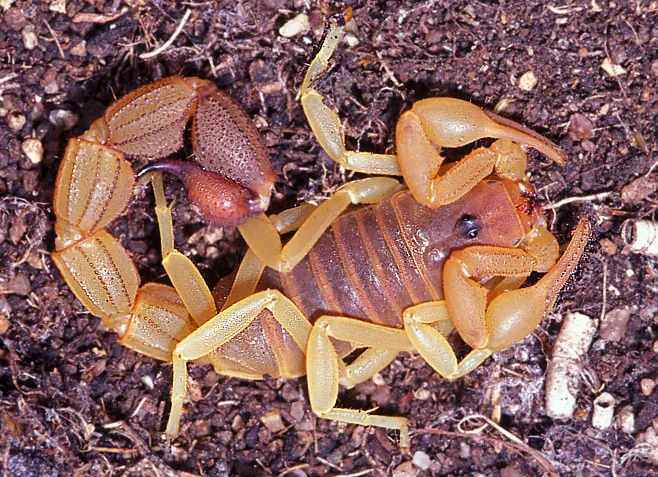
If you've found a scorpion indoors, the answer isn't a can of spray and hoping for the best. Scorpions are tough, they hide for days without moving, and they only come inside because the garden around the house suits them. Proper scorpion control means finding where they're sheltering, treating those places and the entry points with a residual product, and reducing the insects they hunt. That's how we approach it across Pretoria and Centurion, and after 25 years we know which parts of the city keep us busiest.
Why Pretoria has more scorpions than people expect
Scorpions love rock, and Pretoria is built around it. The ridges and koppies that run through the city, from the Magaliesberg side in the north to Klapperkop and the Waterkloof Ridge in the south-east, give them exactly the loose stone, cracks and dry ground they need. Homes built up against those slopes, or with rockeries, stone retaining walls and natural boulders left in the garden, see far more scorpions than a flat stand with a lawn and paving.
The Highveld calendar matters too. Scorpions are most active on warm summer nights, especially after a thunderstorm has flooded their hiding places and sent them looking for somewhere drier. In winter they slow right down, so a scorpion found in July has usually been sheltering in the house or garage for a while.
Thick tail or big pincers? What you're looking at
There's a simple rule most South Africans learn early, and it's a good one: look at the tail and the pincers. Scorpions with thick, heavy tails and small, slender pincers rely on their venom, and those are the ones to treat with real caution. Scorpions with big, chunky pincers and a thin tail rely on grabbing their prey, and while a sting hurts, it's usually much less serious.
Don't pick one up to check. If you can, put a glass over it and slide a piece of card underneath, or take a clear photo from a safe distance and WhatsApp it to us. If anyone is stung, particularly a young child, an older person or someone with health problems, get medical advice straight away rather than waiting to see how it goes.
Where we find them
- Under rocks, paving slabs, pot plants and stacked bricks
- In rockeries, stone walls and gaps in retaining walls
- Inside pool pump and gate motor housings, and in meter boxes
- Under loose bark, wood piles and old garden furniture
- Indoors: in shoes, under bath mats, behind skirting, in the garage and in boxes stored on the floor
How our scorpion treatment works
1. Inspection
We walk the property looking for harbourage: rockeries, wall cavities, gaps under doors, cracks where the paving meets the house, and anything stacked against an outside wall. We also look at what they're eating. A garden full of crickets, cockroaches and other insects at night will always attract scorpions.
2. Targeted residual treatment
We apply an odourless, non-staining residual treatment to the places scorpions hide and travel: around the foundations, door and window thresholds, the base of boundary and retaining walls, rockeries, the garage and outbuildings. Indoors we treat skirting, behind appliances and other dark edges where they shelter. You don't need to move out. Keep children and pets off treated surfaces until they're dry.
3. Cutting the food supply
Treating the insects scorpions feed on is part of the job, not an extra. Fewer crawling insects means fewer reasons for scorpions to hang around the house. If spiders are part of the picture as well, our spider control in Pretoria can be done on the same visit.
4. Follow-up and advice
On rocky stands we may recommend a follow-up treatment during the warm months, and we'll show you which changes to the garden will make the biggest difference.
The mistake we see all the time
People find one scorpion, spray it with an aerosol insect killer and think the job is done. Scorpions are remarkably resistant to quick knock-down sprays, and the spray does nothing about the twenty others living in the rockery. Worse, a half-sprayed scorpion often crawls off and hides somewhere you'll put your hand later. Deal with the place they live, not just the one you can see.
A Pretoria tip worth knowing
Scorpions glow a bright blue-green under ultraviolet light. A cheap UV torch, used in the garden an hour or two after dark on a warm evening, will show you exactly where they're active: along a particular wall, around the pool pump, in one corner of the rockery. That tells you, and us, where to focus. Households on the ridges often find it eye-opening.
Prevention around the house
- Move rocks, bricks, pots and wood piles away from the walls of the house.
- Fit brush strips to the bottom of outside doors, especially sliding doors to the patio.
- Shake out shoes, boots and gardening gloves left outside or in the garage.
- Keep beds pulled slightly away from the wall and bedding off the floor in rooms that open onto the garden.
- Switch off or reduce outside lights near doors at night. Lights draw insects, and insects draw scorpions.
What does scorpion control cost?
It depends mostly on the property. A standard suburban house with a small garden is a quick job. A large stand against a koppie, with long stone walls, rockeries and outbuildings, takes more time and product, and may need a second treatment in summer. Estates and schools are quoted on the area and how many buildings are involved. If you've seen one scorpion in ten years, a brush strip on the door and moving the woodpile may be all you need, and we'll tell you that honestly.
Homes, estates and schools
For families with toddlers, we focus on bedrooms, play areas and the paths between the house and the garden. Security estates on rocky ground often benefit from treating neighbouring homes together, because scorpions move freely along shared walls. Schools and crèches can include scorpion treatment in a regular service plan. We do a lot of this work in the hillier suburbs; see scorpion control in Waterkloof, scorpions around Montana's koppies and our Faerie Glen scorpion treatments. If you're also finding large centipedes, read about centipede control across Pretoria, because they like the same hiding places.
We're SAPCA registered, and our treatments carry a 3-month guarantee: if scorpions come back within three months of treatment, we come back too. Call 012 012 5526, or WhatsApp us a photo of the scorpion and we'll tell you what it is.
Questions we get asked
Are the scorpions in Pretoria dangerous?
Some can be. As a rule, scorpions with thick tails and small pincers have stronger venom, while those with large pincers and thin tails are usually less dangerous. Get medical advice for any sting on a child or vulnerable person.
Why do I find scorpions in the bath?
They usually fall in while hunting at night and can't climb the smooth sides. It means they're getting into the house, often under a door or through a gap near the bathroom.
Will a spray from the shop kill scorpions?
Not reliably. Scorpions are resistant to quick knock-down sprays, and spraying one does nothing about the others hiding nearby. A residual treatment of their hiding places works far better.
Should I remove my rockery?
Not necessarily. Keeping rockeries away from the house walls, clearing loose debris and treating the rockery itself usually brings numbers down without losing the garden.
When are scorpions most active?
On warm summer nights, especially after rain. They slow down a lot in the cold Highveld winter.
Is scorpion treatment safe for my dogs?
Yes, once it has dried. Keep pets off treated areas until the surfaces are dry, and we'll tell you which areas we've treated.