
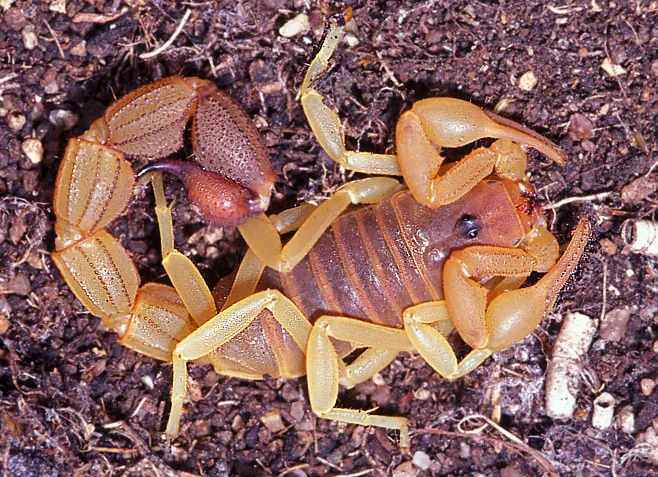
If you're finding scorpions in the house, the garage or around the pool, they're coming from shelter close by: loose rocks, stacked stone, cracks in a retaining wall, a woodpile or debris along the boundary. The treatment that works is to deal with those hiding places and the routes into the house, not to spray the kitchen floor. First, though, it's worth knowing what kind of scorpion you have.
Thick tail or big pincers?
South Africa has two broad groups, and a quick look tells you a lot:
- Thick tail, small pincers. These are the more venomous scorpions. Their sting can be serious, especially for children, the elderly and people with health problems. Treat any sting from one as a medical matter.
- Big pincers, thin tail. These rely on their claws to catch prey, and their sting is generally painful but much less dangerous. Many burrowing scorpions found in gardens fall into this group.
Send us a photo and we'll tell you which you're dealing with. If someone has been stung and you're unsure, get medical advice rather than waiting.
Why the ridge matters
Scorpions need shelter during the day, and the Waterkloof Ridge offers plenty. Rocky slopes, terraced gardens, dry-stone walls, boulders left in place when houses were built and loose stone along driveways all hold scorpions. Many stands here have been landscaped with large rockeries, and gaps under rocks are exactly where they hide. Lower down, where gardens are flatter and soil is deeper, you'll see fewer.
Scorpions are most active on warm summer nights, especially after rain, when their prey of crickets, beetles and other insects is out in numbers. They often come into houses under doors, through gaps around pipes, or via garages that stand open in the evening.
Where scorpions turn up indoors
- Shoes, boots and gardening gloves left in garages or on the stoep
- Bathrooms and kitchens, especially near drains and pipes
- Under rugs, towels and clothes left on the floor
- In garages, storerooms and pool pump rooms
- Inside beds that touch the wall in ground-floor rooms
How we treat scorpions
Outside first
We inspect the rockeries, retaining walls, woodpiles, garden borders and the base of the house, and treat the sheltered gaps and crevices where scorpions hide and hunt with a residual product.
Around the house
We apply a barrier treatment around doorways, garage entrances, airbricks, pipe entries and the perimeter, so scorpions crossing it pick up the product before they get inside.
Inside where needed
We treat garages, storerooms and the edges of rooms where scorpions have been found.
Advice
We'll show you which gaps to seal and which garden features are giving them the most cover.
Children's play areas, sandpits and spots where people walk barefoot at night get extra attention on stands with young families.
What gets people into trouble
Picking up stones, pots or firewood bare-handed in the garden, or putting on shoes left outside without shaking them. Most stings on the ridge happen that way. The other mistake is assuming that one treatment makes the garden scorpion-free. On a rocky stand they'll always be around; the aim is to keep them out of the house and away from where people walk.
A local tip
Fit door sweeps or rubber seals to the bottom of external doors, especially ground-floor doors facing the rockery or slope, and keep the garage door closed at night. On ridge properties, these two steps stop most scorpions from getting into living spaces.
What does scorpion control cost?
It depends on the size of the property, how much rockery and walling there is to treat, the number of outbuildings and whether the house needs treating inside as well. Steep or terraced stands with a lot of stonework take longer. If you've seen one scorpion in a season, sealing doors and keeping the garage closed might be enough. Regular sightings indoors are a different story, and we'll quote after looking at the property.
Scorpions behave much the same across the city's rocky areas; our scorpion control page for Pretoria goes into more detail. Rocky gardens on the slopes also shelter spiders and centipedes, so see spider treatments in Waterkloof and centipedes in Waterkloof gardens. The full list of local pests is on our Waterkloof pest control page, and we do similar work across scorpion control in Garsfontein.
We're SAPCA registered and have been at this for 25 years. Our treatments carry a 3-month guarantee: if scorpions come back into the house in that time, we return. Phone 012 012 5526 or WhatsApp us a photo of the scorpion.
Questions we get asked
Which scorpions are dangerous?
As a rule of thumb, scorpions with thick tails and small pincers are the more venomous. Those with big pincers and thin tails are usually less dangerous, though their sting still hurts.
What should I do if someone is stung?
Keep them calm and still and get medical advice, especially for children or if the scorpion had a thick tail. A photo of the scorpion helps the doctor.
Why are there so many scorpions on my property?
Rocky ground, retaining walls and rockeries give them shelter, and a garden with plenty of insects gives them food. Ridge properties naturally have more.
When are scorpions most active?
On warm summer nights, especially after rain, when insects are plentiful. In cold winter months they're much less active.
Can you make my garden completely scorpion-free?
Not on a rocky stand. We focus on keeping them out of the house, garages and places where people walk and play.
Do UV torches really show scorpions?
Yes. Scorpions glow under ultraviolet light, so a UV torch is a useful way to check rockeries and walls at night.