
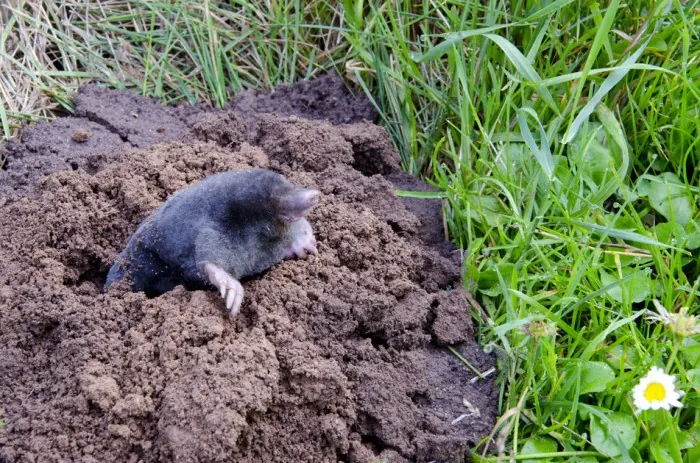
Raised ridges snaking across the grass, soft patches that collapse underfoot and mounds of fresh soil in the flowerbeds usually mean one of two animals is working under your garden. The first job is to tell which, because a golden mole and a mole-rat are not the same animal and aren't dealt with the same way. Then we work on the active tunnels, not the old ones.
Two different diggers
Golden moles
Golden moles are small, blind insect-eaters. They tunnel just below the surface while hunting for earthworms, beetle grubs and other soil life, which is why their runs show up as raised, cracked ridges in the lawn rather than big mounds. They're easiest to spot after a storm or a long irrigation cycle, once the ground softens and the grubs move up. They don't eat your plants, but the tunnels lift lawns, dry out roots and make a mess of carefully kept grass.
Mole-rats
Mole-rats are rodents. They dig deeper and push up proper mounds of loose soil, and they do eat roots and bulbs. If your agapanthus, irises or vegetables are dying from below and there are fresh soil heaps nearby, a mole-rat is the more likely culprit.
Why Waterkloof gardens get them
Much of it comes down to age and care. Lawns and beds on established stands have been irrigated, composted and mulched for a long time, so the soil is deep, rich and full of invertebrates. Big lawns give a mole plenty of room, and the open ground between Waterkloof properties and the green spaces nearby means a new one can wander in once the last has gone. Gardens lower down, with deeper soil, tend to see more activity than the rockier stands up on the ridge, where stony ground makes digging harder.
How we deal with moles
- Identify the animal. Ridges or mounds, depth of tunnels and what's being damaged tell us whether it's a golden mole or a mole-rat.
- Find the active runs. We flatten sections of tunnel and see which ones are reopened. Treating abandoned runs is a waste of time.
- Target those runs. For mole-rats, which are rodents, traps set in the active tunnel are the main method. For golden moles, the focus is on the active feeding runs and reducing what draws them.
- Follow up. Moles and mole-rats are territorial, so once the resident has gone, we check whether another has moved in.
What doesn't work
Plenty of remedies get passed around: bottles in the ground, windmills, chillies, flooding the tunnels, car exhaust down the hole. Some of these are dangerous and most simply move the animal a few metres. Flooding in particular tends to make golden moles more active, because wet soil brings worms closer to the surface. We'd rather save you the effort.
What people get wrong
Many owners assume the ridges are made by the same animal that's eating their bulbs. Often they're not. Golden mole runs and mole-rat mounds can appear in the same garden, and fixing one doesn't fix the other. The other common mistake is mistaking harvester termite damage for moles. Bare, sandy patches with small holes and cut grass are termites, not moles, and need a completely different treatment.
A local tip
Waterkloof gardens are often irrigated on automatic systems that run whether the lawn needs it or not. Watering less often but more deeply, and letting the top layer of soil dry between cycles, makes the surface less attractive for golden moles hunting close to the top. It also helps the kikuyu cope with winter.
What does mole control cost?
It depends on the size of the lawn and beds, how many active tunnel systems there are, which animal we're dealing with and how many follow-up visits are needed. A single mole-rat working one bed is a small job. A large lawn with several active systems, or a garden with both animals, needs more time. We'll look first and tell you what's realistic.
For more on how moles behave across the city, read about mole control in Pretoria. If your lawn problem is bare patches rather than ridges, harvester termite treatment in Waterkloof is what you need, and everything else we treat in the suburb is on the Waterkloof pest control page. We also work on gardens nearby through mole control in Garsfontein.
We've been doing this for 25 years, we're SAPCA registered and our treatments come with a 3-month guarantee. Call 012 012 5526, or WhatsApp us a photo of the ridges or mounds so we can tell you which animal it is.
Questions we get asked
Do golden moles eat my plants?
No. Golden moles eat insects, grubs and worms. If roots and bulbs are being eaten from below, a mole-rat is the more likely cause.
How do I know if a tunnel is still active?
Press a section of the ridge flat and check the next day. If it's been pushed up again, the run is in use.
Will moles come back after treatment?
They can. When one is removed, another may move into the vacant territory over time, which is why we follow up and suggest ways to make the lawn less attractive.
Is flooding the tunnels a good idea?
Usually not. Wet soil brings worms to the surface, which can make golden moles more active, and it rarely removes the animal.
Are moles more active at certain times of year?
Yes. Activity picks up after rain and when lawns are heavily watered, because soft, moist soil is easier to dig and full of food.