
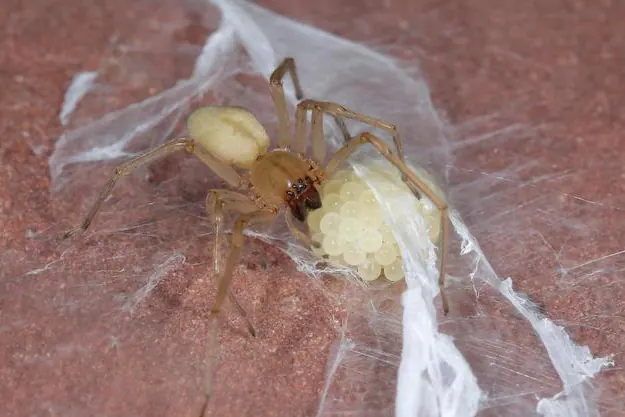
Most spiders in a Waterkloof home are harmless and even useful, eating flies, mosquitoes and moths. The ones people call about are the large rain spiders that appear on walls before a storm, the occasional button spider in a garage or garden pot, sac spiders found in bedding or curtains, and heavy webbing building up under eaves and on patios. We focus on the places spiders live and the insects that attract them, rather than spraying the whole house.
The spiders you're likely to see
Rain spiders
Large, brown and alarming to look at, rain spiders often come indoors in summer, especially before thunderstorms. Females guard a big egg sac wrapped in leaves, sometimes inside curtains or behind shutters. They're not dangerous, though they can give a painful bite if handled.
Button spiders
These are the ones to take seriously. The black button spider, with its round, shiny body and red markings, has a venomous bite that needs medical attention. Brown button spiders are more common around houses and their bite is much milder. Both like sheltered, undisturbed spots: under garden furniture, in pots and planters, in meter boxes, among stacked bricks and in cluttered garages.
Sac spiders
Small, pale spiders that hunt at night and shelter in silk sacs in folded curtains, linen and corners of ceilings. Their bites can be irritating and slow to heal, and they're a common cause of a bite noticed in the morning.
Web builders
Orb weavers and other garden spiders build large webs between trees, along patios and over windows. On a big property with plenty of outdoor lighting, these webs can build up quickly.
Why Waterkloof has plenty of them
Spiders go where the insects are. Mature trees, dense shrubs, flowerbeds and lawns produce a lot of insect life, and outside lights on large houses draw moths and flies every evening. Up on the ridge, rocky slopes, retaining walls and stone rockeries provide sheltered gaps that ground-hunting spiders love. Deep eaves, covered stoeps and outbuildings add even more sheltered corners.
How we treat spiders
- Inspection of eaves, patios, window frames, garages, storerooms, rockeries, garden furniture and any spots you've seen spiders.
- Removal of heavy webbing where it's built up.
- Targeted residual treatment with an odourless, non-staining product on eaves, window and door frames, garage walls and sheltered outdoor spots where spiders rest and hunt.
- Advice on lighting, clutter and garden habits that are drawing them in.
You can stay at home throughout; the only request is that children and pets stay away from sprayed areas until the product has dried. On larger properties we usually include the garage, the pool house and any garden cottage, because webbing and button spiders are often heaviest in the buildings that are used least. Where a residence or an older home has a lot of exterior detail, such as shutters, decorative mouldings or wooden pergolas, we pay particular attention to those, since they offer dozens of small sheltered gaps.
The common mistake
Treating spiders as the whole problem. If your outside lights are pulling in clouds of insects every night, spiders will keep returning however often they're sprayed. Reduce what attracts the insects, and the spiders thin out on their own. The second mistake is reaching into dark spots in the garage or garden without gloves. That's how most button spider bites happen.
A Waterkloof tip
Switch outside lights near doors and windows to warm or yellow bulbs, or put them on motion sensors. Big homes often have a lot of exterior lighting left on all night. Fewer insects around the walls means far fewer spiders on them.
What does spider control cost?
It depends on the size of the house, the number of outbuildings and how much outdoor area needs treating, and whether there's heavy webbing to clear first. If you only see the odd spider indoors, you probably don't need us; a glass and a piece of card will do. A property with a lot of webbing, button spiders in the garage or repeated sac spider bites is worth treating properly.
Find more on spider species and treatment across the city on our spider control page for Pretoria. Homes on the rocky slopes also see scorpions; read about scorpions on Waterkloof Ridge. If the real problem is the insects drawing the spiders, flying insect control in Waterkloof is the place to start. The main Waterkloof pest control page covers the rest, and we also work on spiders in Lynnwood gardens.
One Stop Pest Control is SAPCA registered with 25 years of experience, and our treatments carry a 3-month guarantee. Call 012 012 5526, or WhatsApp us a clear photo of the spider and we'll identify it for you.
Questions we get asked
Are rain spiders dangerous?
No. They look intimidating but their venom isn't medically significant. They can bite if handled roughly, so move them out with a container rather than your hand.
How do I recognise a black button spider?
It has a round, glossy black body, usually with red markings on the top of the abdomen. If you think you've been bitten by one, get medical help promptly.
Can you get rid of all the spiders in my garden?
No, and you wouldn't want to. Garden spiders control insects. We reduce them around the house, eaves, patios and garages where they bother people.
Why do I keep finding spiders after a storm?
Rain and humidity drive spiders and the insects they hunt indoors, especially rain spiders, which often come in before or after thunderstorms.
What causes a bite I find in the morning?
Sac spiders are a common cause, but mosquitoes, fleas, bed bugs and bird mites also bite at night. A photo of the bite and any insect you find helps us narrow it down.