
Spider control in Lynnwood starts with knowing which spiders you have. The large, alarming-looking ones are often harmless, while the two worth taking seriously are small and easy to overlook. We treat the places spiders shelter and hunt, inside and around the house, and help you take away the insects and clutter that bring them close in the first place.
Why Lynnwood gardens hold so many spiders
Spiders follow food. Lynnwood's mature gardens are full of insects: moths around outside lights, flies near compost and pet areas, crickets and beetles in leaf litter. Thick creepers on walls, dense hedges, wooden pergolas and old outbuildings give spiders shelter close to that food. Eaves and patio roofs on older houses, lit up at night, are a buffet for web builders. And garages, storerooms and wood piles on big stands offer the quiet, dark corners some species prefer.
The spiders worth knowing
Sac spiders
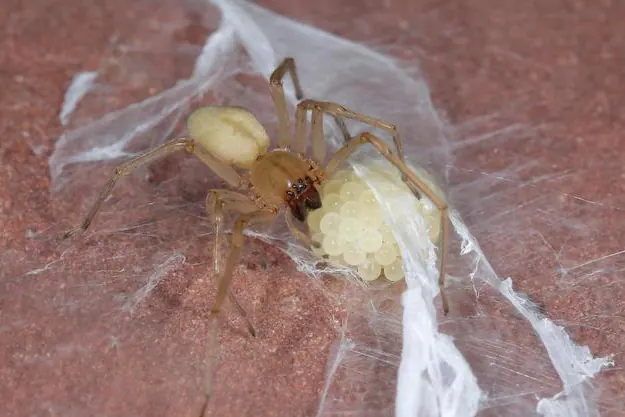
Small, pale yellowish or greenish spiders that hunt at night and rest in silk sacs in folded curtains, behind pictures and in the corners of ceilings. They're one of the most common causes of spider bites in Gauteng homes, often on people asleep in bed. The bite can leave a slow-healing sore, so it's worth seeing a doctor if one becomes inflamed.
Button spiders
The black button spider and the brown button spider both occur on the Highveld. They build untidy webs low down in sheltered spots: under garden furniture, in pot plants, inside meter boxes, under braai stands and among stored bricks and pipes. Brown button spiders often have a distinctive spiky egg sac. Their bites are rare but need medical attention, so take care with gloves when clearing garden clutter.
Rain spiders and the rest
Big, flat, brown huntsman spiders, the ones that appear on walls before a storm, look frightening but are generally harmless and best caught under a glass and released outside. Garden orb weavers, wall spiders and jumping spiders are harmless too, and they eat a lot of insects.
Signs you have more spiders than you'd like
- Webs re-forming under eaves, in window frames and around lights within days of being swept away
- Silk sacs in curtain folds, ceiling corners and behind furniture
- Bites in the morning, especially on exposed arms and legs
- Untidy webs low down in meter boxes, under garden furniture or in the garage
How we treat spiders
We inspect the house and garden to identify the species and find where they're living. Then we apply an odourless, non-staining residual treatment to the places spiders rest and travel: under eaves, around window and door frames, along skirting, behind furniture, in garages and storerooms, and in meter boxes and low garden shelters where button spiders sit. We remove webs as we go. It isn't a blanket spray of the whole garden, which would also kill the insects your birds feed on.
What people get wrong
Treating the spiders but not the lights. A bright outside light near the door draws moths and flies all night, and the spiders follow. Switching to a warm yellow bulb, or moving the light away from the door and windows, cuts the insect supply and the number of spiders that set up there. The other mistake is killing every rain spider on sight while ignoring the clutter where button spiders live.
A Lynnwood tip
Creepers are lovely on old face-brick walls, but where ivy, bougainvillea or Virginia creeper grows right up to the windows and eaves, it gives spiders a sheltered highway into the house. Keep a clear gap of about a hand's width around window frames and below the roof, and you'll see fewer spiders indoors.
What does it cost?
It depends on the size of the house, how many outbuildings and storerooms need treating, and how heavy the activity is. A home with webs under the eaves is a modest job. A big property with a cottage, a double garage and a pool room takes more. If you've seen the odd spider and nothing else, a broom, a jar and a yellow light bulb might be enough.
Spiders and scorpions often turn up in the same rockeries and wood piles, so see scorpion control in Lynnwood if you've seen both. For the city-wide service, read spider control in Pretoria, or spider treatments in Faerie Glen for homes near the nature reserve. Other local pests are on pest control for Lynnwood.
We're SAPCA registered, with 25 years in the business. Treatments carry a 3-month guarantee: if the spiders come back within that time, so do we. Call 012 012 5526, or WhatsApp us a photo of the spider and we'll tell you what it is.
Questions we get asked
Which spiders in Lynnwood are dangerous?
Button spiders and sac spiders are the two to take seriously. Rain spiders and most garden spiders look scary but are harmless to people.
I woke up with a bite. Was it a spider?
It could be a sac spider, but many night-time bites are mosquitoes, fleas, bed bugs or bird mites. A photo of the bite or any insect you find helps us tell.
Should I kill rain spiders?
There's no need. They're harmless to people and eat insects. Catch one under a glass and put it outside if you'd rather not share the room.
Will spider treatment harm my garden birds?
We don't spray the whole garden. Treatment goes on walls, eaves, frames and sheltered spots, which keeps the impact on birds and other wildlife low.
How do I keep spiders out of the garage?
Clear the clutter off the floor, store things in sealed boxes on shelves, seal the bottom of the door and sweep webs away regularly.