
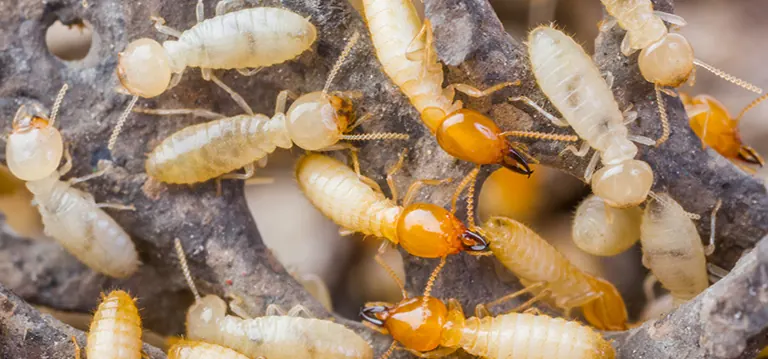
If you've spotted mud tubes on a Lynnwood wall, papery skirting boards, or flying termites coming out of a crack indoors, book an inspection before you buy any spray. Termite work in this suburb is mostly about older houses that lost their original soil protection years ago, and big lawns that harvester termites strip in winter. The two need completely different treatments, so identifying the species comes first.
Why termites find Lynnwood houses
Lynnwood was built up a long time ago, and many homes still have the features termites enjoy: suspended timber floors, wooden built-in cupboards, parquet, and roof timbers that have never been checked. Whatever soil treatment went in under the foundations when the house was new stopped working long ago. Since then, owners have added paving, patios, extensions and raised flowerbeds, and each change can open a new path from the soil into the building.
The gardens add to it. Mature trees drop leaves and twigs that rot into mulch against the walls. Old tree stumps, buried building rubble and forgotten timber edging all feed colonies in the soil, and a big colony in the garden is only a short tunnel away from your skirting boards.
The signs, room by room
- Built-in cupboards and wardrobes: thin mud lines up the back panel or along the base, often found only when you empty them.
- Timber and parquet floors: boards that feel soft, sound hollow or have small soil spots pushed up between them.
- Door and window frames: paint that blisters or cracks in a straight line where termites have tunnelled under it.
- Outside walls: pencil-thick brown tubes running up from the soil, usually behind shrubs or flowerbeds.
- The lawn: bare sandy patches with small holes and cut grass pieces, which is harvester termite activity and no threat to the house.
How we treat termites in Lynnwood
We start with a full inspection of the foundations, floors, cupboards, frames and roof space, plus the garden. Once we've confirmed subterranean termites, we find where they enter: expansion joints, cracked slabs, plumbing through walls, timber touching soil. We then apply a registered soil treatment to build a treated zone along and under the structure. Where paving or a slab makes drilling impractical, baiting is often the better route. For harvester termites, we treat the active openings in the lawn so the foragers carry the product down to the colony. Heavy infestations get a follow-up visit to confirm the tubes stay dead.
The mistake that makes things worse
Ripping the tubes open and spraying whatever crawls out feels like action, but it only kills a few workers. The colony reroutes, often deeper inside a wall where it's harder to trace. Leave the tubes intact until we've seen them. They show us exactly where the activity is coming from.
Another one: assuming bare lawn patches are a grass or fertiliser issue. If harvester termites are cutting it, re-seeding just feeds them. Some lawn damage in Lynnwood is moles instead, and our page on moles in Lynnwood gardens explains how to tell the difference.
A local prevention tip
Walk the outside of the house and look at the flowerbeds against the walls. In older Lynnwood gardens, beds have often been topped up with compost year after year until the soil sits above the damp-proof course. Pull it back so you can see a strip of bare wall, and termites lose one of their easiest, hidden routes in. While you're there, remove old timber edging, stacked firewood and any stumps near the house.
What does it cost?
Harvester termite treatments in a lawn are a fairly modest job, priced on the area affected. Structural termite work depends on the perimeter length, whether we drill through paving, how much damage there is, and whether baiting suits the house better. Large older homes with several additions take more work than a compact newer one. We quote after the inspection, because a termite job can't be priced honestly over the phone.
Termites or flying ants?
After the first summer storm, Lynnwood gardens fill with winged insects. Termite alates have straight bodies and four equal wings that drop off easily. Flying ants have a pinched waist and bent antennae. If you're seeing ants rather than termites, our Lynnwood ant treatments are what you need.
For the wider picture, see termite control across Pretoria and Centurion, or our work on the ridge next door with Waterkloof termite treatments. Other pests in the suburb are listed on our Lynnwood pest control overview.
We're SAPCA registered with 25 years of termite work behind us, and our treatments carry a 3-month guarantee. Found tubes or damage? Call 012 012 5526, or WhatsApp us a photo and we'll tell you what you're looking at.
Questions we get asked
My Lynnwood house is old. Is it still protected from termites?
Almost certainly not by the original treatment. Soil treatments done at construction wear off over time, and later paving and extensions disturb them, so older homes are worth inspecting.
Can termites get into parquet or timber floors?
Yes. Subterranean termites will eat floor timbers from underneath, often through gaps at the walls or where pipes come through the floor.
Is the bare patch in my lawn termites or something else?
Small holes with loose soil and cut grass pieces point to harvester termites. Raised ridges and soft spots are more likely moles.
Will treatment damage my garden?
No. Soil treatments are applied along the structure, and lawn treatments go into the active holes, so your beds and lawn are left intact.
Should I remove the old tree stump near my house?
Yes, if you can. Rotting stumps close to the house are a common food source that keeps a termite colony going right next to your walls.