
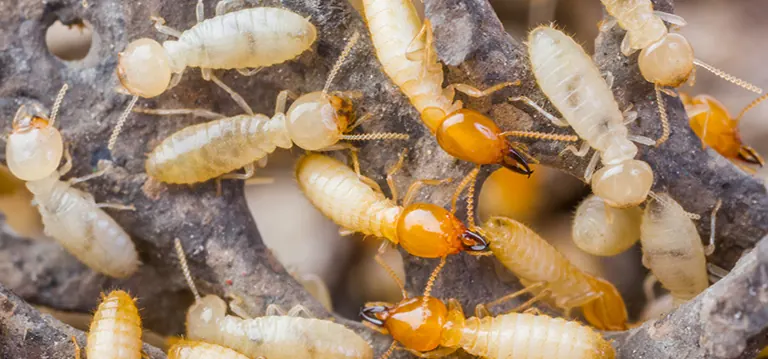
If your Faerie Glen lawn is going bare in patches, or you've found mud tubes on a wall, the answer starts with identifying the termite. Harvester termites cut grass. Subterranean termites eat timber. They need completely different treatments, and in this suburb you can easily have both on the same property. An inspection tells us which one you're dealing with, how active it is, and where it's coming from.
Why termites are so common in Faerie Glen
Natural Highveld grassland is where termites belong. The reserve protects a large stretch of it, and colonies there have nothing to disturb them. Gardens on the edge of the suburb are, from a termite's point of view, just more grassland with better irrigation. That's why so many of our calls from Faerie Glen come from homes close to the reserve, and why the bare patches often appear first along the boundary wall and spread inward.
The ridges add another layer. Rocky, shallow soil drains fast and dries out quickly in winter, and harvester termites do their worst damage on stressed, dry grass. A lawn on a slope that gets full winter sun is a prime target.
Is it the lawn termite or the house termite?
Harvester termites
You'll see small round holes in the soil with loose crumbs of earth around them, and short, neatly cut pieces of grass lying nearby. On cool, overcast afternoons the workers come out to forage and you might spot them carrying grass back to the hole. They won't touch your house, but they can clear a kikuyu lawn during a dry winter.
Subterranean termites
These stay hidden. Look for thin, brown mud tunnels on foundations or inside cupboards, skirting that sounds hollow, paint that blisters, or flying termites emerging from a crack indoors after the first summer storm. Older homes with timber floors and built-in cupboards, and any house where flowerbeds have been built up against the walls, are most at risk.
How we treat termites here
- We confirm the species and map the activity, inside and out.
- For harvester termites, we treat the active nest openings across the lawn so the workers carry the product underground to the colony. On large gardens near the reserve, we may treat in stages and return to catch holes that reopen.
- For subterranean termites, we use registered soil treatments to create a treated zone at the foundations, or baiting where drilling through paving isn't practical.
- We follow up, because a colony next to open grassland has plenty of neighbours.
What people often get wrong
The usual mistake is fixing the lawn instead of the termites. Residents re-seed, top-dress or lay new turf on the bare patches, and within weeks the new grass is cut down too. The other is breaking open mud tubes and spraying them with an aerosol. That kills a handful of workers and pushes the rest out of sight, which makes the colony harder for us to trace.
Prevention that suits a reserve-edge garden
- Water the lawn through winter if you can. Healthy grass recovers, dry grass gets stripped.
- Keep soil and bark mulch below the damp-proof course, especially on the side of the house facing the reserve.
- Don't stack firewood or old timber against walls or along the back boundary.
- Look at your lawn closely in May, before the dry season really bites. Treating early is far easier than repairing a bare garden in September.
Moles also churn up lawns in this area, and the damage can look similar from a distance. If you see raised ridges rather than holes, our page on moles in Faerie Glen gardens will help. Flying termites are often mistaken for ants too, and ant treatment in Faerie Glen covers the difference.
What does it cost?
A harvester termite treatment is priced on the size of the affected lawn and how many visits it takes. Structural termite work costs more and depends on the length of the perimeter, the amount of drilling through paving or slabs, and whether baiting suits the site better. We quote after the inspection. A single harvester hole in a small garden is sometimes manageable with a registered product from a garden centre, and we'll say so if that's your situation.
For the wider picture across the city, see termite control throughout Pretoria, and if you're just over the boundary, our Garsfontein termite service deals with very similar lawns. Other pests in the suburb are listed on our Faerie Glen pest control overview.
We're SAPCA registered, and if termite activity returns within three months of treatment, we return as well. Call 012 012 5526, or WhatsApp us a photo of the holes or tubes and we'll tell you which termite it is.
Questions we get asked
Why are the bare patches worst near my back wall?
Because that's the side closest to the reserve grassland. Harvester termite colonies from the open ground forage into the nearest lawn first, then work inward.
Do harvester termites mean my house is at risk?
No. Harvester termites only take grass and plant material. A house is only at risk from subterranean termites, which we check for separately.
Can I just re-plant the lawn?
Not until the termites are treated. New grass on an active harvester colony gets cut down just like the old grass did.
When is the best time to treat harvester termites?
As soon as you see fresh holes and cut grass, ideally at the start of winter. That's when activity rises and the lawn is most vulnerable.
Is termite treatment safe for my dog?
Yes, when it's used as directed. Keep pets off the treated lawn until it has dried, and they can go back out after that.
Can termites from the reserve reach a house in a complex?
Subterranean termites can reach any building on soil, complexes included. Paving and shared walls don't stop them, so complexes near open ground benefit from a site inspection.