
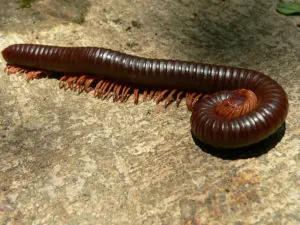
Millipedes are best kept out with a barrier treatment around the house, combined with changes to the damp, mulched ground right next to the walls. You don't need to get rid of every millipede in the garden. Outdoors they're useful, breaking down dead leaves and plant matter. The aim is to stop them crossing the threshold in their dozens.
Why Faerie Glen sees millipede surges
The big black or dark brown "shongololos" so familiar to Highveld children are millipedes, and so are many smaller species you might not recognise. They live in leaf litter, compost, mulched beds, under logs and in the thatch of lawns, feeding on decaying plant material. Faerie Glen's established gardens and the natural grassland of the reserve both supply plenty of that.
In summer, after a run of storms, conditions change quickly. Soil becomes waterlogged, and millipedes move up and out, often in large numbers, looking for new ground. Many of them simply wander until they hit a wall, then follow it. Doors, weep holes, gaps under garage doors and air bricks become their way in. Once inside, they usually dry out and die within a day or two, which is why people find them curled up dead on the floor in the morning.
Signs you have a millipede problem rather than a few visitors
- Dozens appearing on patios, walls and paving in the evenings after rain
- Many found inside, especially in garages, laundries and ground-floor rooms
- Curled, dead millipedes being swept up every morning
- A distinctive smell when you crush or disturb them, which some species release as a defence
Millipedes are not centipedes
They look similar at a glance but behave very differently. Millipedes are slow and rounded, curl up when disturbed and have two pairs of legs on each body segment. They don't bite. Centipedes are flat, quick, predatory and can bite. If what you're seeing is fast and flat, our page on Faerie Glen centipede treatments is the one you want.
Handling millipedes safely
Some millipede species release a fluid that can irritate skin and stain it a yellowish or brownish colour. It's not dangerous, but don't let small children handle them, keep the fluid away from eyes, and wash your hands after picking one up. Dogs that mouth millipedes sometimes drool and paw at their face for a while afterwards.
How we deal with millipedes
We start by working out where they're coming from, which is usually the beds, mulch and lawn edges closest to the house. Then we apply an odourless, non-staining residual barrier around the foundations, door thresholds, weep holes, garage doors and paving edges. Millipedes crossing it are killed before they get indoors. Where numbers are very high, we may treat the immediate beds and lawn edge too. No one needs to leave the house, but keep pets and children off the treated strip until it's dry.
What people often get wrong
Spraying the whole garden. It's unnecessary, kills plenty of useful creatures and doesn't last, because millipedes keep arriving from neighbouring gardens and open ground. A good barrier along the house, and a drier strip next to the walls, does far more.
Simple changes that help
- Pull mulch, compost and leaf litter back from the house walls and paving edges.
- Turn off irrigation near the house for a while during a wet summer spell.
- Seal gaps under doors with door sweeps, and check that air bricks have fine mesh.
- Raise pot plants on feet rather than standing them directly on paving.
- Sweep millipedes off the patio in the evening and move them back into the garden, away from the house.
A note for complexes
Townhouse complexes with shared lawns and landscaped verges, especially on the reserve side, can get millipede surges across several units at once. A barrier treatment along the whole row of units and common paving edges is more effective than owners treating their own doorsteps at different times.
What does it cost?
Millipede barrier treatments are usually straightforward. The price follows the perimeter of the house or units, the number of doors and garages, and whether beds and lawn edges need treating as well. If you see a handful after a storm, a sweep and some drier beds will probably do, and you don't need to call us.
Millipedes are part of the wider group we cover on crawling insect control in Faerie Glen. See also millipede control for Pretoria, and if you're slightly west of us, millipedes in Garsfontein gardens. Our Faerie Glen pest control page lists the rest.
We're SAPCA registered, and if millipedes come back through the barrier within three months, we'll re-treat. Phone 012 012 5526, or WhatsApp us a picture of what's coming in.
Questions we get asked
Are millipedes harmful?
No, they don't bite or sting. Some release a defensive fluid that can irritate skin and stain it, so wash your hands after touching them.
Why are millipedes dying inside my house?
They need moisture. Once they wander indoors they dry out quickly, so you find them dead or curled up on the floor.
Do millipedes damage plants?
Mostly they eat decaying plant matter. In large numbers they may nibble seedlings or soft fruit lying on the ground, but they're generally harmless in the garden.
When do millipede invasions happen?
Usually in summer after heavy or repeated rain, when waterlogged soil pushes them out of the ground and into new areas.
Is my dog in danger if it bites a millipede?
Usually not seriously, but the defensive fluid can cause drooling and irritation. Rinse the mouth with water and call your vet if it seems unwell.
Will the barrier keep out other crawling insects too?
Yes, a perimeter treatment also helps against ants, crickets and other crawling insects trying to get in at ground level.