
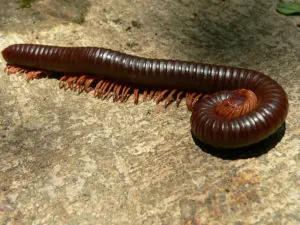
Millipedes in Montana are mostly a seasonal nuisance rather than a real threat. They don't bite, sting or damage the house. But when they come in big numbers after summer rain, climbing walls, getting into the pool and curling up inside doorways, a perimeter treatment combined with a few garden changes brings them back down to a level you won't notice.
Why millipedes suddenly appear in their hundreds
Millipedes, which most South Africans know as shongololos, feed on decaying plant matter: leaf litter, rotting wood, compost, mulch and soft dead roots. They live in damp soil and under garden debris for most of the year. Then, after the first proper summer storms, the soil becomes waterlogged and many species become active and start moving in search of mates and drier ground. That's when they appear on walls, paving and inside the house, often in large numbers.
Montana's newer gardens tend to be generous with mulch, bark chips and compost, because new beds need help to establish. That's good for plants, and it's also a feast for millipedes. Properties that back onto veld see the large black and brown species crossing into the garden from the grassland too. The more organic material near the house, the more millipedes you'll find on the walls.
What you'll see
- Millipedes climbing outside walls, especially the shaded side of the house
- Dozens curled up in a spiral on paving, steps and patios in the morning
- Them gathering in pool skimmers, garage doorways and under door mats
- A few dried, dead ones inside along skirting boards, which means they're getting in but can't survive indoors
Some large millipedes release a defensive fluid that can stain skin and irritate eyes, so it's best to wash your hands if you've handled them and keep them away from pets' mouths.
Millipede or centipede?
Millipedes are round, slow-moving and curl up when touched. They have two pairs of legs per body segment. Centipedes are flat, fast and run away. If yours are quick and flat, see our page on centipede control in Montana, because they're a different creature with a different approach.
How we treat millipedes
Our approach is focused on the outside of the house, where the problem lives. We inspect the garden for heavy mulch, compost, leaf litter, wood and damp areas near the walls. Then we apply a residual perimeter treatment along the foundation, around doorways, garage thresholds, weep holes and the edges of paving, to stop them reaching the house. Where they're breeding in heavy mulch beds close to the walls, we'll show you how far back to pull it. Indoors, there's usually little to treat, because millipedes dry out and die quickly inside.
Nobody needs to leave home for this. We just ask that dogs and children stay off the treated strip around the house until it's dry.
What people get wrong
Many people sweep millipedes away every morning and spray the paving with an insecticide from the shop. That kills the ones on the surface, but the bigger population in the mulch beds and compost remains untouched. Another mistake is thinking a millipede invasion means something is wrong with the house. It doesn't. It's a response to rain and the organic material in the garden.
A Montana tip
In late spring, before the storms arrive, rake back bark mulch and leaf litter from the walls of the house and move the compost heap away from the building. A gravel strip along the foundation instead of mulch makes a real difference. If the pool sits near a flowerbed, check the skimmer daily in December and January, because millipedes collect there and clog it.
Complexes and estates
In complexes, millipedes often build up in the common gardens, where mulch is spread generously and nobody clears leaf litter from the base of walls. If several units are affected, it's far more effective for the body corporate to arrange a treatment of the shared beds along with the unit perimeters.
What does millipede control cost?
Price depends on the length of the perimeter to treat, the size of the garden and whether the common areas of a complex are included. A single townhouse is a small job. A large property next to veld, or a full complex, costs more. Honestly, if you're seeing a few millipedes for a couple of weeks after rain, you probably don't need a treatment. Clearing mulch from the walls and waiting for drier weather may be enough.
Millipedes are just one of many crawling pests, and our page on crawling insect treatments in Montana covers the bigger picture. We also treat millipedes in Lynnwood, and the citywide service is under millipede control across Pretoria.
We've been treating Highveld homes for 25 years, and we're SAPCA registered. If a treated millipede problem comes back within three months, we'll come back to sort it. Call 012 012 5526, or WhatsApp us a photo of what's on your wall.
Questions we get asked
Are shongololos poisonous?
They don't bite or sting. Some release a fluid that can irritate skin and eyes, so wash your hands after touching one and keep them away from pets' mouths.
Why are millipedes only bad in summer?
Summer rain soaks the soil and triggers them to move in search of mates and drier ground, which brings them up walls and indoors.
Do millipedes eat my plants?
Mostly no. They feed on decaying plant matter, though they can occasionally nibble seedlings or soft fruit lying on the ground.
Why do I find dead millipedes inside?
They wander in through gaps under doors but dry out quickly indoors, so they die along skirting and in corners.
Will removing mulch really help?
Yes. Pulling mulch and leaf litter back from the walls removes their food and shelter near the house.