
Crawling insects in a Montana home are best handled by treating the band around the outside of the house, sealing the gaps they use to get in, and dealing with each insect inside using the right bait or product. A barrier treatment on its own helps, but combining it with targeted baits for ants and cockroaches, and fixing the damp and clutter near the walls, is what gives a lasting result.
The zone that matters
Think of your house as having a buffer zone: the metre or so of ground along its walls, plus the doorways, weep holes, drains and pipes that pass through them. Nearly every crawling insect that ends up inside crosses that zone. In Montana, many homes are surrounded by fresh landscaping: mulch, irrigated beds, rockeries and paving laid on sand. That's ideal habitat right at the foundation line, which is why crawling insects reach the door so easily.
Open veld and koppies close to many properties mean there's also a large supply of insects nearby, ready to move into gardens.
Crawlers we see most in Montana
- Ants: nesting under paving and along walls, coming in through cracks and pipe gaps.
- Cockroaches: German roaches in complex kitchens, American roaches from drains and sewer lines.
- Centipedes and millipedes: pushed out of soil and mulch by summer rain.
- Fishmoths: living in boxes, cupboards and garages.
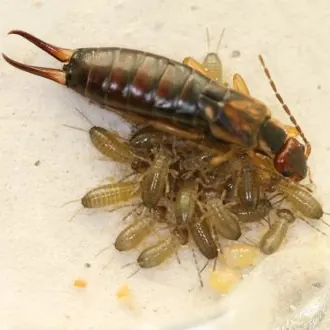
- Crickets and earwigs: sheltering under pots and debris near doors, coming in at night.
- Scorpions and spiders: technically not insects, but they use the same routes. We treat them as part of the same job.
For two of the most persistent, see cockroach control in Montana and Montana ant treatments.
How we treat crawling insects
We start by walking the perimeter of the house and the garden, then move inside to the kitchen, bathrooms, garage and storage areas. We look for nests, harbourage, entry points and moisture. Outside, we apply an odourless, non-staining residual barrier along the foundation line, door thresholds, weep holes, paving edges and around drains. Inside, we use the method that suits each insect: gel bait for cockroaches, ant bait along trails, residual treatment along skirting and in cupboards for fishmoths. We'll then show you the gaps worth sealing and the garden changes that make the biggest difference.
No one needs to leave the house during treatment. The treated barrier outside just needs to dry before pets and children walk on it.
What people get wrong
Treating the inside of the house again and again while the outside stays the same. If your foundation line is buried under damp mulch and the paving next to the wall is full of ant nests, insects will keep coming in no matter how often you spray the kitchen. Another common mistake is spraying a barrier treatment straight onto ant trails that are already carrying bait. It stops the workers taking bait back to the colony.
A local tip
Look at the base of your outside walls and ask whether an insect could walk from cover to the door without crossing open ground. In many Montana gardens, the answer is yes, because beds, mulch or pot plants run right up to the walls. Create a gap of bare paving or gravel along the foundation, keep irrigation off the walls, and fit brushes to the bottom of outside doors.
Complexes and estates
In complexes, crawling insects move along shared walls, plumbing ducts and common gardens. A barrier around one unit helps that unit, but a treatment of the whole block's perimeter, arranged through the body corporate, works far better. We can also set up regular visits for estates and complexes where insect pressure from the veld is constant.
What does crawling insect control cost?
Most of the cost comes down to how long the perimeter is, the number of insect types involved, the size of the house and any follow-up visits. A townhouse with a small ant problem is a simple job. A large estate home with cockroaches, ants and centipedes and a long boundary onto veld takes more. If it's one insect in one spot, a specific treatment may be cheaper than a full barrier, and we'll say so.
For the full list of pests we handle in the suburb, see the Montana pest control page. We also treat crawling insects in Lynnwood, and our citywide service is described under crawling insect control in Pretoria.
With SAPCA registration and 25 years on the job, we guarantee our work for three months. If crawling insects return within three months of treatment, our guarantee brings us back. Call 012 012 5526, or WhatsApp us a photo of what's coming in.
Questions we get asked
What is a perimeter barrier treatment?
It's a residual treatment applied along the outside of the house, at the foundation, doorways and weep holes, to stop crawling insects getting in.
How long does a barrier treatment last?
It depends on the weather and on irrigation. Heavy summer rain and sprinklers hitting the walls shorten it, which is why we cover treatments with a 3-month guarantee.
Will a barrier keep cockroaches out of my complex unit?
It helps with roaches coming from outside, but German cockroaches inside a complex need gel bait and, ideally, treatment of neighbouring units.
Are earwigs and crickets harmful?
No. They're a nuisance rather than a danger, and they usually come in at night through gaps under doors.
Do I need to move pot plants before treatment?
It helps. Moving pots and mats away from the walls lets us treat the foundation line properly.
Why do crawling insects get worse after rain?
Rain floods nests and hiding spots in soil and mulch, so many insects move upward and towards drier shelter, which is often your house.