
Most spiders in Montana homes are harmless and some are actually useful, but if they're everywhere, or if you've seen a button spider or sac spider near where your family sleeps or plays, it's worth treating. We target the places spiders hide and the insects that feed them, rather than spraying the whole house.
Why Montana has plenty of spiders
A suburb built close to open veld and rocky koppies has a large spider population right on its doorstep. Spiders live in grass, under rocks, in rockeries and in the cracks of retaining walls. When land is developed, the spiders don't leave. They move into garden walls, garages, under stoeps and into the gaps under doors. New gardens with fresh rockeries, stacked paving and building materials left over from construction give them even more places to settle.
Spiders also follow their food. Homes with bright outside lights attract flying insects at night, and those insects attract spiders. If your patio light is on every evening, you'll notice more webs around it by morning.
The spiders you're most likely to meet
Rain spiders
These are the large, brown, flat spiders that come indoors before and after summer storms. They're alarming to see but harmless to people, and they eat other insects.
Button spiders
The black button spider has a shiny black body, usually with red markings, and a messy, tangled web low down in sheltered places such as under garden furniture, in water meter boxes and in rockeries. The brown button spider is more often found around homes, in corners of patios and under eaves. Button spider bites need medical attention, so if you've seen these near children or pets, treat it seriously.
Sac spiders
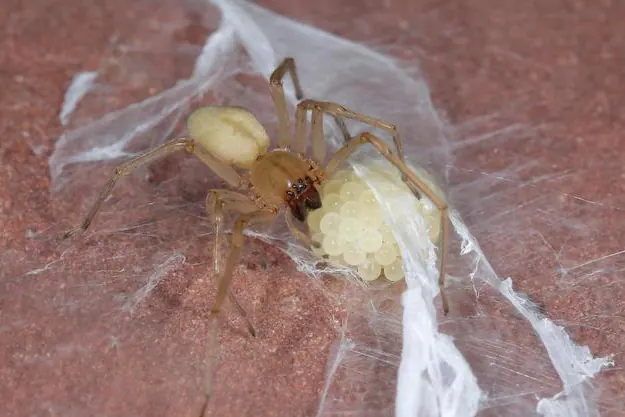
Small, pale yellow or greenish spiders that hide in folded curtains, clothing and the corners of ceilings by day and wander at night. Their bites can cause a slow-healing sore, so they're worth controlling indoors.
Baboon spiders
Large, hairy, burrowing spiders that live in the veld and occasionally turn up in gardens bordering open land. They rarely come indoors, they're an important part of the veld, and they're best left alone or gently moved with a container.
How we deal with spiders
We inspect the house and garden to find where spiders are concentrated and which species you have. Then we apply a targeted, odourless, non-staining residual treatment to those areas: eaves, window frames, door thresholds, garage corners, under the stoep and along garden walls. We remove webs as part of the job. Where flying insects are drawing spiders in, we'll talk to you about lighting and, if needed, treat the insect problem too. You can stay home throughout, though little ones and pets should stay off the sprayed patio and walls until everything has dried.
Spiders in estates and complexes
In Montana estates, the units on the outer edge, closest to the veld or a koppie, usually see far more spiders than those in the middle. Common areas with ornamental rocks, retaining walls and thick planting add to the pressure. If several households on the boundary are struggling, a treatment of the perimeter wall and common gardens arranged with the estate manager tends to help everyone at once.
What people get wrong
Spraying the inside of the house over and over with a shop aerosol. It might kill the spider you aimed at, but it does nothing about the spiders living in the garden walls, the rockery and the garage, which are where the new ones come from. Another is squashing button spiders by hand, which is how many bites happen. Use a broom, wear gloves, or call us.
A local tip
If your Montana garden has a rockery, a pile of leftover paving or stacked building materials, move them away from the walls of the house. These are prime spider and scorpion habitat. Switch to yellow outside bulbs or turn patio lights off when you're not using them, and you'll notice fewer webs within a week or two.
What does spider control cost?
The quote is shaped by how much garden and how many outbuildings we need to cover, plus any follow-up visits. A standard home with webs around the eaves is a simple job. A larger property backing onto veld, with outbuildings and rockeries, takes more. If you're simply seeing the odd rain spider before a storm, you probably don't need treatment at all.
Spiders and scorpions often share the same hiding spots, so see scorpions in Montana gardens if you've seen both. For the full list of local pests, there's the Montana pest control overview. We also treat spiders in Lynnwood, and our general service is on spider control across Pretoria.
We're SAPCA registered and have worked on Highveld properties for 25 years. Spider treatments carry our 3-month guarantee: if the problem returns in that time, we return too. Call 012 012 5526, or WhatsApp us a photo of the spider and we'll tell you if it's one to worry about.
Questions we get asked
Are rain spiders dangerous?
No. They look intimidating, but rain spiders are harmless to people and help control other insects.
How do I recognise a button spider?
Look for a small, round, shiny body, black or brown, often with red or orange markings, in a messy web low down in sheltered spots.
Should I kill baboon spiders in my garden?
No. They rarely enter homes and do no harm to the house. If one is in the wrong place, move it gently with a container and release it in the veld.
Why are there so many webs around my outside lights?
Lights attract flying insects at night, and spiders build where the food is. Turning lights off or switching to yellow bulbs helps.
Will one treatment get rid of all the spiders?
It reduces them a lot, but spiders keep coming in from the veld. Removing hiding spots and food sources makes the difference last.
Can you treat for spiders in a complex garden?
Yes, and in shared gardens we can work with the body corporate on the common areas as well.