
The first thing to know about spiders in Garsfontein is that very few are dangerous, and most come for one reason: other insects. Outside lights, patio roofs, eaves, garages and dense garden beds attract moths, flies and beetles, and spiders follow the food. A good treatment deals with the spiders where they hide and cuts down what they're feeding on, which is what keeps them away for longer.
The spiders we see most
Rain spiders
Big, brown and alarming, rain spiders often come indoors just before or after summer storms, and they're the source of a lot of panicked calls. They're not aggressive, and a bite is rare. Usually the best thing is to move one outside in a container.
Sac spiders
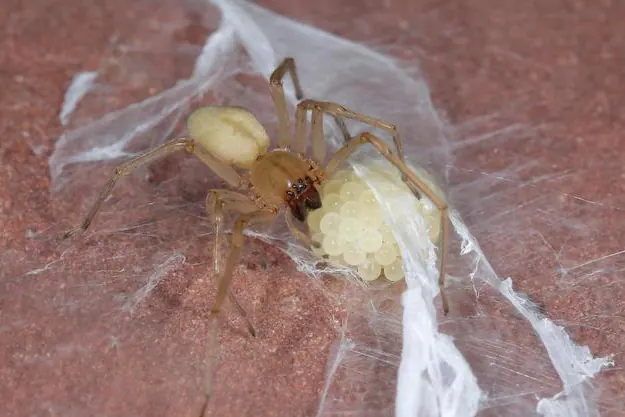
Small, pale and active at night, sac spiders build little silk pockets in the corners of ceilings, curtain folds and behind picture frames. They're responsible for many of the bites people find in the morning, which can blister and take a while to heal.
Button spiders
These are the ones to take seriously. Black and brown button spiders (widow spiders) build messy, tough webs low down: under garden furniture, in pool-pump housings, in the corners of wendy houses, behind stacked pots and in meter boxes. Their bite needs medical attention. In family gardens, it's worth checking spots where children reach in or sit.
Daddy-long-legs and garden orb weavers
Thin-legged cellar spiders gather in garages, ceilings and storerooms, while orb weavers string big wheel webs between trees and across paths. They're harmless, though a heavy build-up of webs is messy.
Violin spiders are found in parts of South Africa and are sometimes blamed for bites in Pretoria, but most bites people bring to us turn out to be sac spiders, fleas or something else entirely. If a bite is spreading, blistering badly or making someone feel unwell, see a doctor first and worry about identifying the spider afterwards.
Where spiders build up around the house
Eaves and the undersides of patio roofs near outside lights are the busiest spots. Garages with stacked boxes, bikes and camping gear give them shelter. Thick creepers on walls, rockeries and pot plants clustered against the house are popular outside. In complexes, the shared boundary walls and covered parking bays tend to get webs fast.
How we treat
We inspect the outside of the house and the garage, then apply an odourless, non-staining residual treatment to eaves, window frames, the patio roof, the garage and the base of walls, along with targeted treatment of webs and hiding places. Removing old webs and egg sacs is part of the job. Indoors, we treat corners, skirting edges and behind furniture where needed. You don't need to go anywhere while we work. Keep kids and pets off treated areas until dry.
The mistake to avoid
Knocking down webs with a broom and calling it done. The spider simply rebuilds overnight, often in the same spot, because the lights and insects are still there. Webs come back fastest where an outside light stays on all night. Long-handled brushes are useful for clearing old webs after a treatment, but on their own they only buy a day or two.
A local tip: change the outside lights
Many Garsfontein homes have security lights on the patio, carport and front door that stay on from dusk to dawn. Bright white light pulls in flying insects from across the garden, and spiders set up right next to it. Switch to warm or yellow-toned bulbs, use motion sensors where you can, and keep lights mounted away from doors and windows. You'll see far fewer webs.
What does spider control cost?
It depends on the size of the house, the length of the eaves and patio areas, and whether the garage and outbuildings are included. A townhouse with a small patio is a short job. A big freestanding home with a double garage and a long covered entertainment area takes longer. If you only see the occasional rain spider, you probably don't need us at all. Catch it under a glass and let it go in the garden.
Spiders often share hiding places with scorpions under rockeries and pots, and our Garsfontein scorpion control page explains what to look for. For the full city-wide picture, visit spider control in Pretoria. We treat spiders in the large gardens of Waterkloof too, and the other pests we handle locally are on the Garsfontein pest control page.
Our spider treatments are guaranteed for three months: if they come back in that time, so will we. A clear photo sent on WhatsApp lets us identify the spider before we visit, or you can ring 012 012 5526 to book.
Questions we get asked
Are rain spiders dangerous?
No. They look scary because of their size, but they're not aggressive and their bite is rarely a problem. They usually come indoors around storms.
How do I recognise a button spider?
Look for a shiny, round-bodied spider in a messy, strong web low down in sheltered places. Black button spiders may have a red mark; brown ones have an hourglass shape underneath.
What should I do if a button spider bites my child?
Get medical help straight away. Their bite can cause serious symptoms and needs to be assessed by a doctor.
Why are there so many webs around my outside lights?
The lights attract insects at night, and spiders build where the food is. Changing to warmer bulbs or motion sensors helps.
Will the treatment kill the spiders in the garden?
We focus on the house, eaves, patio and garage. We don't blanket-spray the garden, where most spiders are harmless and help control other insects.
How often should spiders be treated?
For most homes, once a season or when webs build up again is enough. Homes next to open ground or with a lot of outdoor lighting may need it more often.