
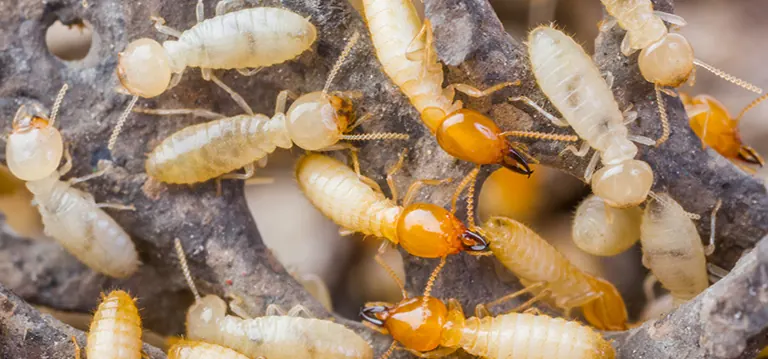
If your Garsfontein lawn is thinning into sandy patches with small holes, it's almost certainly harvester termites, and it can be treated without touching the house. If you've found brown mud tubes on a wall, inside a cupboard or along the garage floor, that's subterranean termites, and you should have the house inspected before the damage spreads. Telling them apart is the first thing we do on every termite visit.
Why lawns here take a beating
Garsfontein is a suburb of family gardens. Many homes have a kikuyu lawn that doubles as the cricket pitch, the dog's run and the place the trampoline stands. Through a dry Highveld winter those lawns go dormant and stressed, which is exactly when harvester termites do their worst. They come up through small openings, cut the grass into short pieces and carry it underground. By the end of winter, a lawn that looked fine in autumn can be bare in large patches.
The signs are easy to spot once you know them:
- Small round holes in the soil, often with a little ring of loose soil around them
- Short, neatly cut grass pieces lying near the holes
- Pale, busy workers on the surface late in the afternoon or on overcast days
- Patches that stay bare even after you water
The quieter problem inside the walls
Subterranean termites never show themselves in the open. They build sealed mud tunnels to reach timber, and they're after door frames, skirting boards, built-in cupboards, roof timbers and the boxes of old school projects stored on the garage floor. In older freestanding homes, the soil treatment applied when the house was built has long since worn off. Extensions, new paving and raised flowerbeds against a wall all create fresh routes in. In complexes, units on one slab can share the same problem, so one owner's discovery is worth passing on to the body corporate.
Flying termites after the first big summer storm are normal across Pretoria. They only point to a problem in your house if they're coming out of a wall, a floor crack or a window frame indoors.
How we handle it
- We confirm the species. Lawn termites and timber termites need different products and different methods.
- For harvester termites, we treat the active openings so the foragers carry the product down to the colony. Timing matters: we treat when they are actively foraging.
- For subterranean termites, we trace the tubes back to where they enter, then apply a registered soil treatment around and under the affected structure, or use baiting where drilling isn't practical.
- We check back. Heavy activity needs a follow-up visit to make sure the holes have stopped reopening and the tubes stay dead.
The mistake we see in Garsfontein gardens
People spend money on lawn dressing, fertiliser and new runners to fix the bare patches, and the termites simply harvest the new growth. Treat first, then repair the lawn. The same goes for indoor tubes: scraping them off and spraying with a can only kills the workers you can see, and it removes the trail we would have followed to find the source.
Prevention that suits a family garden
Keep watering the lawn lightly through winter when water restrictions allow. A stressed, dry lawn is far more attractive to harvesters than one that still has a bit of life in it. Around the house, keep soil and bark chips below the damp-proof course, don't let a jungle gym's wooden poles or a wendy house sit straight on bare soil without a check now and then, and fix dripping taps that keep one corner of the foundation wet.
What does termite control cost?
A harvester termite treatment is priced on how much of the lawn is affected and is usually the smaller job. Structural termite work depends on the length of wall to be treated, whether paving or a slab has to be drilled, and how much timber has been reached. One or two holes in a corner of the lawn can sometimes be handled with a product from a garden centre, and we'll say so. We won't price a structural job without seeing it.
For the full picture of how we approach termites city-wide, see termite control across Pretoria. Raised ridges in the lawn rather than holes are more likely moles, which we cover under mole control in Garsfontein. Next door, we do plenty of termite work in Moreleta Park, and the rest of what we treat locally is on our Garsfontein pest control page.
Our termite treatments come with a 3-month guarantee: if activity returns in that time, we come back. Ring 012 012 5526 to book an inspection. A WhatsApp picture of the lawn or the tubes is often enough for us to say which termite you have.
Questions we get asked
Why is only part of my lawn going bare?
Harvester termites forage from specific colony openings, so damage starts in patches around those holes and spreads outwards. Shady or dry corners often go first.
Can harvester termites get into my house?
No. Harvester termites eat grass and dry plant material, not timber. If you see mud tubes on walls or inside cupboards, that's a subterranean species and needs a separate inspection.
When is the best time to treat lawn termites?
When they are visibly foraging, which in Pretoria is mostly in the cooler, drier months and on overcast afternoons. Treating when the openings are active lets the workers carry the product down.
Is the lawn treatment safe for my dog?
Yes, once it's dry. Keep pets and children off the treated area until then, and we'll tell you how long that is on the day.
We have a wooden jungle gym. Should I worry?
It's worth checking the poles where they meet the soil once or twice a year. Look for mud on the timber or wood that sounds hollow when you knock it.
Do I need to tell my body corporate about termites?
It's a good idea. Units on a shared slab or with joined walls can be affected by the same colony, and a block treatment is usually more effective than one unit at a time.