
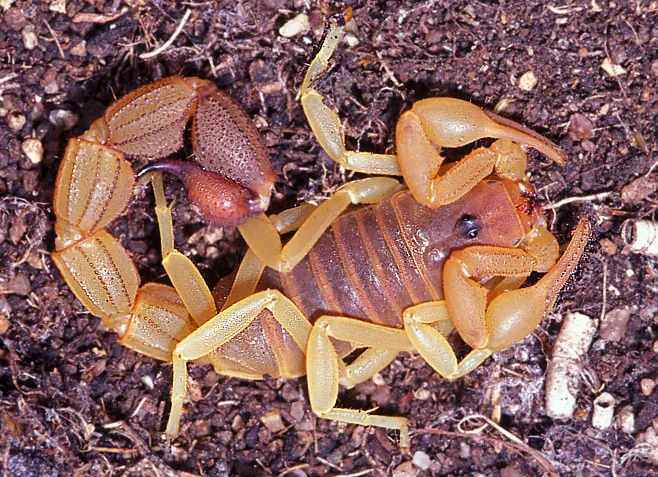
Scorpions in Garsfontein are mostly an outdoor animal that wanders inside by accident. They shelter by day under stones, pot plants, paving slabs, loose bricks, wood piles and garden edging, and hunt insects at night. You can't make a garden scorpion-free, but you can make the house and the areas where your family walks barefoot far less inviting. That's what our treatment is about.
Which scorpions should worry you?
There's a simple rule South Africans learn early: look at the tail and the pincers. Scorpions with thick tails and thin, small pincers rely on venom, and some of these can give a dangerous sting. Scorpions with big, chunky pincers and a thin tail rely on their claws and generally have a mild sting, painful but not dangerous for most healthy adults.
Most of what we find around Pretoria East homes falls into the second group. But it's not worth taking a chance with children, elderly family members or anyone allergic. If someone is stung by a thick-tailed scorpion, or a sting is causing anything more than local pain, get medical help straight away.
Where they turn up in Garsfontein properties
- Under pot plants on patios and around the pool, especially pots standing directly on paving
- In rockeries, stone borders and loose brick edging
- Beneath paving slabs that have lifted or sunk
- In wood piles, stacked building materials and old timber next to the boundary wall
- Inside pool-pump and meter boxes
- Indoors: bathrooms, laundries and shoes or clothes left on the floor
Summer is the active season. Warm nights and the insects that come with the rains bring scorpions out to hunt, and they sometimes walk in under a door that doesn't seal.
What we do
We look at the property through a scorpion's eyes: where can it hide by day, where does it hunt at night, and how would it get inside? Treatment goes into those places specifically, with residual products applied around the foundations, along the base of walls, under and around pot plants, into rockery gaps and around door thresholds and weep holes. We also cut down the insects they feed on, which matters more than people expect.
It's targeted work, not a blanket spray of the garden. You don't have to leave home, and once treated areas are dry, children and pets can use them again.
A common misunderstanding
A lot of people assume a scorpion indoors means a nest in the house. Scorpions don't nest the way insects do. One in the bathroom is almost always a wanderer that came in under the door or through a gap. The fix is at the edge of the house, not inside the cupboards.
Practical precautions for families
Teach children to shake out shoes left outside or on the floor, and to look before reaching under pot plants, stones and toys left lying on the lawn overnight. Wear gloves when moving bricks, pots or wood. Keep the beds pulled away from walls and don't let bedding trail onto the floor.
A Garsfontein tip: lift the pots
Patios and pool areas in this suburb tend to be lined with big pots standing flat on the paving. That damp, dark gap under the pot is a perfect daytime hiding spot. Put the pots on small pot feet so there's a clear gap underneath. It reduces scorpions and also stops the paving staining. Sweep under them now and then.
If you use a UV torch, try a walk around the garden on a warm evening. Scorpions glow under ultraviolet light, which shows you quite quickly whether the rockery or the pool area is where they're coming from.
What does scorpion control cost?
The quote reflects how big the stand is and how much hiding space it offers: rockeries, stone walls, paving, wood piles and outbuildings all add to the time. A townhouse with a small walled garden is a short job. A larger stand with a rock garden and a long boundary wall takes more. If you've seen one scorpion in five years, a tidy-up of pots and wood piles may be all you need.
Scorpions often share the same cover as spiders. Our page on spiders around Garsfontein homes covers button spiders, which like the same places. Find out more about scorpions city-wide on our Pretoria scorpion control page. Homes on the rocky slopes of Waterkloof get them more often than most, and our wider local service list is on the Garsfontein pest control overview.
Our scorpion treatment comes with the usual 3-month guarantee: if they're back inside within that time, we'll return. To book, phone 012 012 5526. If you can safely take a photo of the scorpion, send it on WhatsApp and we'll tell you which kind it is.
Questions we get asked
How can I tell if a scorpion is dangerous?
Look at the tail and the pincers. Thick tails with small pincers usually mean a stronger venom; big pincers with a thin tail usually mean a milder sting.
What should I do if my child is stung by a scorpion?
Keep the child calm and get medical advice straight away, especially if it was a thick-tailed scorpion or symptoms go beyond local pain.
Do scorpions nest inside houses?
No. Scorpions don't build nests. One indoors has usually wandered in from the garden, under a door or through a gap.
Why do I see more scorpions in summer?
Warm nights and the insects that come with the rains get them out hunting. In winter they're far less active.
Will the treatment harm my garden?
No. We treat specific hiding places and the edge of the house, not the whole garden, and the products we use won't stain.
Can I use a UV torch to find scorpions?
Yes. Scorpions glow blue-green under ultraviolet light, which makes a night-time check of the garden much easier.