
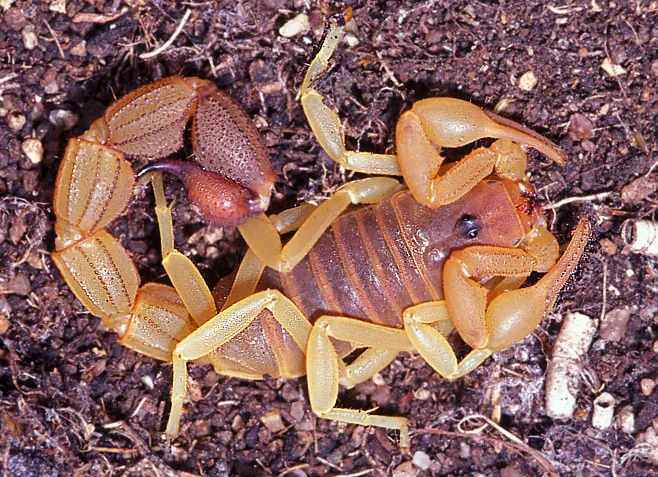
If you've found a scorpion in or around your Moreleta Park home, the practical steps are to find where they're sheltering, treat those places, and make the garden less attractive to them. Scorpions are night hunters that spend the day under stones, in cracks and under loose debris, so the treatment goes where they hide, not over the whole property.
Where scorpions come from in this suburb
The homes most likely to see scorpions are those near undeveloped ground: the newer estates on the edges of the suburb, properties backing onto veld, and gardens near the open strip along the Moreleta Spruit. Ground that was rocky veld until recently still holds scorpion populations, and building work and new gardens disturb them and push them into homes.
In the older parts of the suburb, the attraction is usually the garden itself. Rockeries, stone retaining walls, packed-stone edging around beds, wood piles and stacks of pavers left over from a building project make perfect shelter. Garden insects provide the food.
Which scorpions are dangerous?
A useful rule of thumb in South Africa is to look at the tail and the pincers. Scorpions with thick tails and thin, slender pincers tend to have the stronger venom and should be treated with caution. Scorpions with large, heavy pincers and a thin tail rely more on their claws and are generally less dangerous, although their sting is still painful. It's a rough guide rather than a guarantee, so treat any sting seriously, and get medical help quickly for a child, an elderly person or anyone who reacts badly.
Signs you have a scorpion problem
- Scorpions found indoors, especially in bathrooms, under mats or in shoes
- Scorpions under stones, pots or pavers when you lift them
- Sightings around the pool, the patio or retaining walls on warm evenings
- Repeated sightings in the same part of the house, which point to a nearby shelter
An ultraviolet torch makes scorpions glow at night, which is a good way to see how many are around your garden.
How we treat scorpions
- Inspection. We check rockeries, walls, wood piles, paving edges, pool surrounds, door thresholds and drains to find where they're sheltering and how they're getting in.
- Targeted residual treatment. We apply an odourless, non-staining residual product to their shelters and to a barrier around the house, focusing on doors, weep holes, window frames and the base of walls.
- Insect reduction. Scorpions follow their food, so treating crawling insects around the home helps too.
- Practical advice. We'll point out the changes in the garden that cut down on shelter.
What people commonly get wrong
Many people expect a scorpion treatment to work like a fence and keep every scorpion off the property forever. Scorpions are tough and can go a long time without feeding, so the treatment works best combined with removing their hiding places. Others make the opposite mistake and build a new rockery right against the house wall, effectively giving scorpions a home next to the front door.
Prevention
- Move wood piles, bricks, pavers and loose rocks away from the house.
- Fit door sweeps and seal gaps under doors, especially doors that open onto the garden.
- Shake out shoes, boots and towels before use if they've been on the floor.
- Keep beds pulled slightly away from walls, and don't let bedding hang to the floor.
Local tip: properties in the newer estates near the veld often have decorative stone along the base of the boundary wall. That's prime scorpion shelter. If you've got it, consider replacing it with smooth gravel or plants, and check the strip with a UV torch after dark.
What does it cost?
The cost depends on the size of the property, how much rockery and walling there is to treat, and how many outbuildings are involved. A house with a small garden is quick. A large property backing onto the veld, with extensive stonework, takes more time and may need a follow-up. If you've seen a single scorpion once in several years, removing the obvious hiding place nearby might be all you need to do.
Spiders and centipedes often share the same hideouts, so see spider control in Moreleta Park and our page on local centipedes if you're seeing them too. For scorpions elsewhere in the city, see scorpion treatment in Pretoria, or scorpions in Garsfontein nearby. The full local list is on our Moreleta Park overview.
We've dealt with Pretoria scorpions for 25 years and our work carries a 3-month guarantee. Call 012 012 5526, or WhatsApp us a photo of the scorpion and we'll help identify it.
Questions we get asked
Are scorpions in Moreleta Park dangerous?
Some can be. As a rough rule, thick-tailed scorpions with slender pincers have stronger venom. Treat any sting seriously and get medical help if symptoms are severe.
Why do I find scorpions in the bathroom?
They come in under doors and through gaps at night, looking for moisture and insects. Bathrooms often have both.
Can I see scorpions at night?
Yes. Scorpions glow under ultraviolet light, so a UV torch is a good way to check rockeries and walls after dark.
Does building work cause more scorpions?
It can. Clearing land and moving rocks disturbs scorpions that were living there and pushes them into nearby homes.
Will a treatment get rid of every scorpion?
It significantly reduces them around the house, but scorpions are hardy. Removing their hiding places is just as important.
Do you remove snakes as well?
No, we don't handle snakes. For a snake on the property, call an experienced snake handler.