
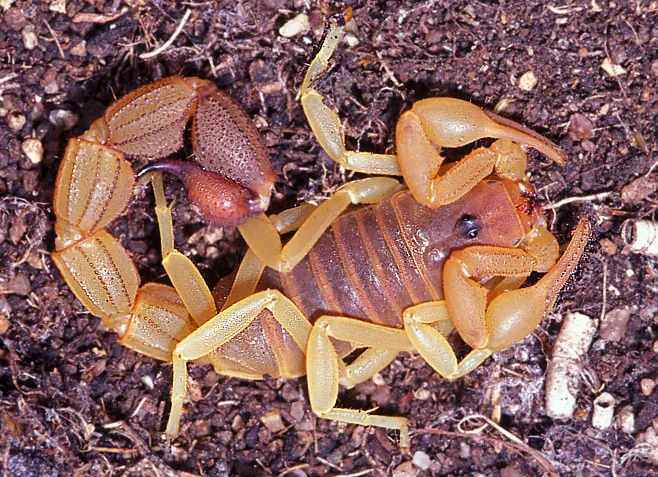
If you've found a scorpion indoors, the first thing to know is whether it's a thick-tailed or a thin-tailed type, because that tells you how cautious to be. The second is how it got in. Scorpions don't breed inside homes in large numbers; they come in from the garden, the veld or a retaining wall nearby. Treating those outdoor hiding places and sealing the gaps at ground level is what reduces the visits.
Why some Centurion homes get far more scorpions
Scorpions are creatures of rocky, dry, undisturbed ground. In Centurion that means homes on the edges of estates bordering open grassland, properties with stone retaining walls and gabions, gardens with big rockeries and koppie-style landscaping, and anywhere building rubble or stacked paving has been left lying around. Newer estates often have a burst of scorpion sightings in the first years, because construction disturbed the ground they were living in and the new walls and rockeries gave them fresh shelter.
Activity peaks on warm summer nights, especially after rain, when scorpions come out to hunt insects. In winter they mostly stay tucked away, so sightings drop sharply.
Knowing what you're looking at
- Thick tail, thin pincers: treat with the most caution. Species with this shape, such as the Parabuthus scorpions, carry the more potent venom. A sting needs medical attention, particularly for children, the elderly and anyone with health conditions.
- Thin tail, big pincers: the burrowing scorpions common in gardens. Their sting is painful, similar to a bee sting for most people, but generally not dangerous.
Don't handle any scorpion to find out. A photo taken from a safe distance is enough for us to identify it.
Our scorpion treatment
We start outside, because that's where the scorpions live. We check rockeries, retaining walls, gabions, stacked materials, wood piles, pool pump housings, meter boxes, the base of boundary walls and the gaps under doors and garage doors. We then apply a residual treatment to those hiding places and to the outside perimeter of the house, and treat entry points such as weep holes, gaps under doors, drains and cracks in the walls at ground level. Inside, we treat the corners, under-sink areas and gaps where scorpions shelter during the day.
Scorpions are tough, and treatment alone won't stop every one. That's why the second part of the job is proofing advice: door seals, closing gaps and tidying the places they hide.
A good habit: the UV torch
Scorpions glow a bright blue-green under ultraviolet light. A small UV torch, walked around the garden walls and patio after dark in summer, shows you exactly where they're active. It's a cheap, surprisingly effective way to check whether a treatment is working and to find hiding spots you didn't know about.
What people often get wrong
Building big rockeries and gabion walls right up against the house, then wondering why scorpions keep coming indoors. Rock features are lovely, but they're scorpion apartments. Keep them a few metres from doors and bedrooms where you can, and keep the area between rocks and the house clear and open.
Simple ways to keep them out
- Fit brush strips or rubber seals under exterior doors and garage doors
- Don't leave shoes, towels or clothes on the floor overnight, especially near outside doors
- Shake out boots and gardening gloves before putting them on
- Move building rubble, old paving, wood and bricks away from the house
- Pull beds a little away from walls in rooms where you've found scorpions
- Reduce the insects they hunt by turning off outdoor lights you don't need
What does it cost?
Scorpion work is priced by how much of the garden and boundary needs treating, how many rock features and outbuildings there are, and whether a follow-up treatment makes sense. A townhouse with a small courtyard is a short visit. A large estate stand that backs onto veld, with long retaining walls, takes more. If you've seen one scorpion in a whole summer, sealing the doors and checking with a UV torch may be enough.
Spiders favour the same rock piles, see spider control in Centurion, and centipedes often turn up under the same pots; Centurion centipede treatments covers those. For more, read about scorpion control across Pretoria, compare our work on scorpions on the Waterkloof Ridge, or see the Centurion pest control overview.
One Stop has 25 years of experience and is SAPCA registered. If scorpions return to treated areas within three months, we come out again. For a booking, phone 012 012 5526, and feel free to WhatsApp a picture of the scorpion first.
Questions we get asked
Which scorpions in Centurion are dangerous?
The ones with thick tails and thin, slender pincers, such as Parabuthus species, have the stronger venom. Thin-tailed scorpions with big pincers are painful but generally less dangerous.
What should I do if someone is stung?
Keep the person calm and still, and get medical help, especially for a child, an elderly person or after a sting from a thick-tailed scorpion. Take a photo of the scorpion if it's safe to do so.
Why are there more scorpions after rain?
Warm, wet summer nights bring out the insects they hunt, and rain can flood their burrows, so they move around more.
Can you get rid of scorpions completely?
Not on a property that borders open veld or rocky ground, because new ones keep moving in. We can reduce them sharply around and inside the house.
Do scorpions live inside the house?
Rarely for long. They usually come in from the garden at night through gaps under doors and weep holes, then hide in dark corners.
Is a UV torch really useful?
Yes. Scorpions glow under ultraviolet light, so a walk around the garden after dark quickly shows where they are hiding and hunting.