
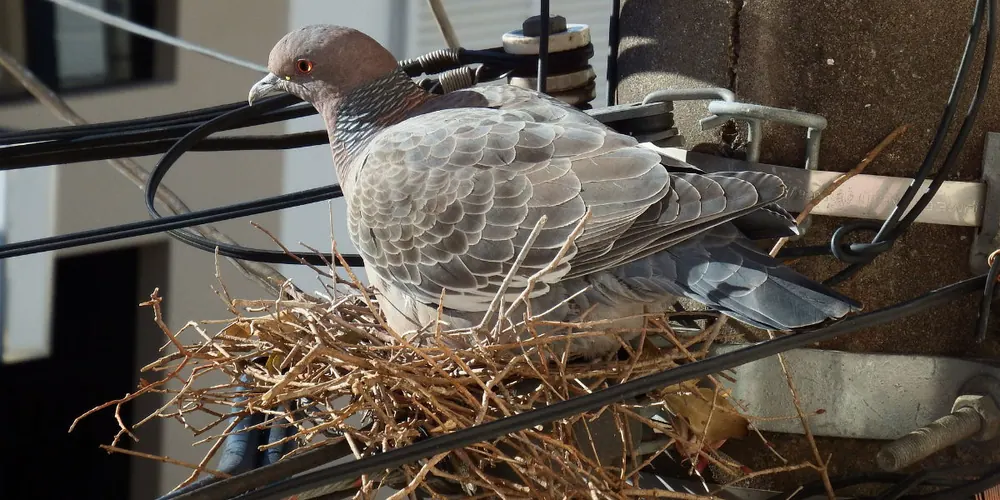
If you're getting itchy bites at night and seeing tiny moving specks on walls, bedding or the window sill, and you have birds nesting in the roof or the eaves, bird mites are very likely the cause. They feed on nesting birds and their chicks. When the chicks fledge or the nest is abandoned, the mites leave in search of a new host and wander into the house. The fix is treating the nest as well as the rooms they've reached.
Where bird mites come from in Centurion
Pigeons, Indian mynas and sparrows nest wherever they can find a ledge with a roof over it. In Centurion that often means gaps under roof tiles, open eaves and fascias, solar geyser frames and panel mounts, air conditioner units and the ledges of office buildings and shopping centres. Office parks with deep window sills and covered walkways often have pigeons roosting along the same ledges year after year. Townhouses in complexes with shared roofs may have a nest above one unit while the mites turn up in the unit next door.
Spring and early summer are the main breeding season, so most bird mite complaints come once the chicks have left the nest.
How to tell it's bird mites
- Very small, pale to reddish specks, barely visible, moving quickly on walls, ceilings, curtains or bedding
- Bites or itching mostly at night or early morning, often around the wrists, neck and waist
- More activity in rooms close to the roof void, window or vent nearest the nest
- Bird activity in the roof: droppings on the walls or solar panels, nesting material poking out under the tiles, chirping in the ceiling
Bed bugs and fleas cause similar bites, but they're bigger and are found in different places. If you're not sure what's biting, our page on biting insects in Centurion walks through the differences, and our bed bug service in Centurion covers the bigger, flat bugs you'd find in mattress seams.
How we treat bird mites
First, we find the nest. That means checking the roof void, eaves, gutters, solar installations and any ledges where birds have been active. We then carry out a targeted nest treatment, treating the nest and the area around it so the mites are killed at the source. Old nesting material is removed where we can reach it safely. Inside, we treat the rooms where mites have appeared, focusing on the routes from the roof: around light fittings, cornices, window frames and ceiling vents.
The final step is advice on keeping the birds out of the roof so a new nest doesn't start the cycle again.
Offices, schools and shopping centres
Bird mites in a workplace cause a lot of worry, because staff assume the bites are coming from the carpets or chairs. In commercial buildings the source is usually pigeons roosting on window ledges, air conditioning units, signage or a plant room on the roof, with mites coming in through windows, vents and ceiling voids. We inspect the outside of the building as well as the affected offices, treat the nests and roosting points we can reach, and treat the offices out of hours. Building managers get a clear note of where the birds are getting in.
What people get wrong
Removing the nest without treating it. If you pull down a nest full of mites, you scatter them and remove their hosts at the same time, which sends them straight into the house. The nest needs treating first, then removing.
The second mistake is assuming the bites are from bed bugs and throwing away bedding or a mattress. Bird mites don't live in mattresses; they come from the roof.
A Centurion tip
Look at your solar panels and geyser frames. Many Centurion homes have added solar in recent years, and the sheltered gap under the panels is now one of the most popular nesting spots for pigeons. Bird-proofing mesh around the edge of the panels, fitted by your solar installer or a roofer, closes that gap. Close gaps under roof tiles and in fascias too.
What does it cost?
Pricing depends on how easy it is to reach the nest, how many nests there are, and how many rooms need treating inside. A single nest in a reachable eave is a short job. Several nests on a double-storey home, or bird activity along an office building's ledges, take longer. Bird proofing itself is usually done by a roofer or your solar installer.
See bird mite control in Pretoria for more background, compare our Garsfontein bird mite treatments, or return to the Centurion pest overview.
Treatments carry our 3-month guarantee, and we're SAPCA registered. If you think birds in the roof are behind your bites, phone 012 012 5526. You can also WhatsApp a photo of the nest, or of the specks on a white tissue, so we can confirm it.
Questions we get asked
Can bird mites live on people?
No. They bite people while looking for a bird host, but they can't complete their life cycle on humans and die off once the source is treated.
Why did the bites start after the birds left?
When chicks fledge or a nest is abandoned, the mites lose their food source and spread out looking for a new host, which brings them into the house.
Are bird mites the same as bed bugs?
No. Bird mites are much smaller and come from bird nests. Bed bugs are larger, flat and live in mattresses and furniture.
Should I remove the nest myself?
It's best not to. Removing an untreated nest scatters the mites into the house. The nest should be treated first.
Do you remove pigeons?
We treat the mites and the nest. For keeping pigeons off the roof, bird-proofing by a roofer or solar installer is usually the long-term answer.
Can you treat an office building?
Yes. We treat nests on ledges, roofs and air conditioning units, and the affected offices inside, planned around working hours.