
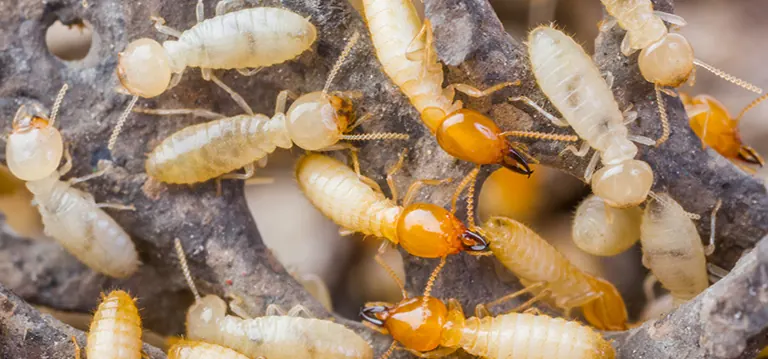
If your lawn is turning bare in winter, you most likely have harvester termites. If you've found mud tubes indoors or timber that sounds hollow, it's subterranean termites, and that needs attention sooner. Telling the two apart is the first thing we do on any Centurion termite call, because the right treatment for one is useless against the other.
Built on grassland, and the termites were here first
A lot of Centurion's estates and complexes went up on land that was open Highveld grassland until fairly recently. Termite colonies in that soil didn't go anywhere when the houses arrived. Harvester termites simply switched from veld grass to the kikuyu on the new lawns, and subterranean colonies found a supply of roof timbers, door frames and cardboard in the garage.
The older suburbs have a different risk. In a house that's been standing for thirty or forty years, the soil treatment applied when it was built has long since worn off, and decades of new flowerbeds, paving and additions have given termites fresh routes to the walls.
Harvester termites: the lawn problem
These termites cut grass and carry it underground to feed the colony. They're most destructive in the dry season, when the grass is already stressed and there's little else to eat. What you'll notice:
- Irregular bare patches that grow from week to week
- Small round holes in the soil with loose, crumbly soil around them
- Short lengths of cut grass lying near the holes
- Workers out on the surface on cool, overcast afternoons
They don't eat buildings. The damage is to the lawn, but on an estate where gardens are a big part of the property's appeal, that matters. We treat the active openings so foragers take the product down into the colony.
Subterranean termites: the building problem
These are the ones to take seriously. They live in the soil and reach timber through mud tunnels, and they work out of sight. Signs include brown mud tubes up foundation walls or inside cupboards, skirting boards that feel soft, paint bubbling over damaged wood, and winged termites coming out of a wall or floor after the first rain. Built-in cupboards against outside walls and garages full of stored boxes are where we often find them first.
We treat these with registered soil treatments that create a treated zone around and under the building, or with baiting where drilling and trenching aren't practical, for example under expensive paving.
How a termite job runs
- Inspection of the garden, foundations, walls, roof space, cupboards and frames, to confirm the species and the extent.
- Tracing the route in, usually through cracks in slabs, expansion joints, pipes and soil heaped against the wall.
- Treatment chosen for the termite and the property, with a clear explanation of what we're doing and why.
- Follow-up to confirm tubes stay dry and lawn holes stop reopening.
The mistake we see in Centurion gardens
Homeowners spend a season re-seeding, top-dressing and fertilising a lawn that harvester termites are eating. The new grass goes the same way as the old. Treat the termites first, then repair the lawn. Indoors, the mistake is breaking open mud tubes and spraying them; the colony is untouched and simply re-routes, and we lose the trail we'd use to find the entry point.
A tip for estate homes
Estate landscaping often has raised beds and mulch built right up against the house. Keep soil and mulch below the damp-proof course and leave a gap of bare ground or paving between the beds and the wall. It removes a hidden bridge into the structure and makes any new mud tubes easy to spot. In winter, keep watering the lawn where water use allows: healthy grass recovers, stressed grass gets stripped.
What does it cost?
A harvester termite treatment is priced on the size of the affected lawn and is usually a modest job. Structural work costs more and depends on the length of the perimeter, whether paving or a slab has to be drilled, how far the damage goes and whether baiting is the better choice. We quote after inspecting, not over the phone. A single new hole in the lawn sometimes settles on its own after rain; we'll tell you if waiting makes sense.
Flying ants after a storm are often termite swarmers, but not always. If you're unsure, compare with our ant treatments in Centurion, and if the lawn has raised ridges rather than bare patches, look at moles in Centurion lawns instead. Our full guide is on termite control across Pretoria, we also treat termites in Garsfontein, and everything else we handle locally is on the Centurion pest control page.
Our treatments carry a 3-month guarantee: if activity returns in that period, we're back to deal with it. If you'd like a quick answer, WhatsApp a picture of the tubes or the lawn, or phone 012 012 5526, and we'll tell you which termite it is.
Questions we get asked
Why does my Centurion lawn get worse in winter?
Because that's when harvester termites forage hardest. Grass is dry and stressed, other food is scarce, and the colony strips whatever it can reach.
Can harvester termites spread to the house?
No. They only eat grass and plant material. Damage to timber in a building comes from subterranean termites, which are a separate problem.
Our complex was built ten years ago. Is it still protected?
Not necessarily. Pre-construction soil treatments wear off, and paving, new beds and alterations disturb them. An inspection will show whether there's activity.
Do I have to move out while you treat?
No. Termite treatments go into the soil and specific points around the building. Keep children and pets off treated ground until it's dry.
Can neighbours be treated at the same time?
Yes, and in estates it's often better. A harvester termite colony can sit under more than one garden, so treating together gives a longer-lasting result.
What should I do if I find mud tubes?
Leave them alone and take a photo. The tubes show us where the termites are travelling, which helps us find the entry point.