
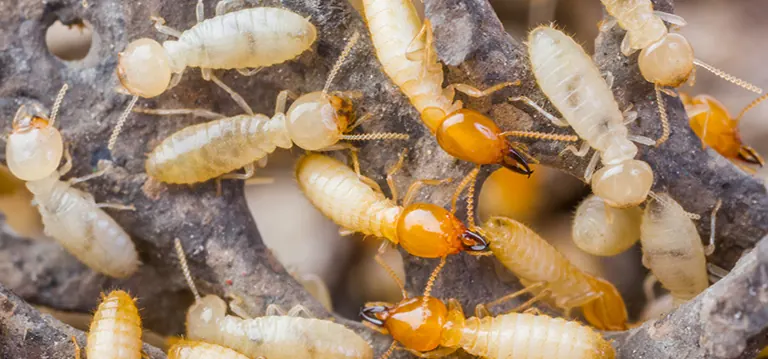
If your Montana lawn is going bald in winter, the cause is almost always harvester termites, and the fix is to treat the active holes so the colony takes the product underground. If you've found thin mud tubes on a wall, in the garage or inside a cupboard, that's a subterranean termite colony and it needs a proper inspection and a soil treatment around the structure. We deal with both, and we always confirm which one you have before quoting.
Why Montana suits termites
Much of Montana was open veld until the complexes and estates went up, and termites were living in that ground long before the bricks arrived. Building clears the grass but doesn't remove the colonies deep in the soil. When a new lawn is rolled out on top, the harvester termites below have a fresh supply of food right above their heads. Koppies and open ground nearby keep new colonies coming, and every summer the first big storm sends swarms of flying termites out to start more.
There's another factor that's easy to miss in newer suburbs. During construction, offcuts of timber, formwork and cardboard sometimes get buried under future flowerbeds or behind retaining walls. To a subterranean termite, that buried wood is an invitation. The colony feeds on it for a few seasons, grows, and then goes looking for more, which can mean your door frames and built-in cupboards.
Harvester termites: what you'll see
- Small round holes in the lawn, about the width of a pencil, often with loose soil heaped around them
- Short pieces of cut grass scattered near the holes
- Bare or thinning patches that spread quickly between May and September
- Workers out foraging in the late afternoon or on overcast days
Harvester termites never touch the house. The damage is purely to the lawn, but on a young kikuyu lawn it can be severe.
Subterranean termites: the warning signs indoors
These are the ones that matter for the building. Look for pencil-thin brown mud tubes running up a foundation wall or a garage pillar, skirting boards that sound hollow, paint that bubbles in a line, or winged termites coming out of a crack in the floor after rain. A swarm in the garden is normal in summer. A swarm from inside a wall is not.
Isn't a new house already protected?
Many new homes received a pre-construction soil treatment, and that helps. It doesn't last forever, though, and it can be broken by later work: new paving, a patio extension, a swimming pool, or flowerbeds dug against the walls. Montana homes are often extended or re-landscaped in their first few years, which is exactly when that protective layer gets disturbed.
How we treat termites in Montana
- Identify the termite. Lawn damage and structural activity look different and are treated differently. We check the garden, walls, garage, roof space and cupboards.
- Trace the source. For subterranean termites, we look for buried timber, cracks in slabs, expansion joints and soil piled above the damp-proof course.
- Treat to match. Harvester termites are treated at their active openings. Subterranean termites get a registered soil treatment around and under the affected structure, or baiting where drilling isn't practical.
- Follow up. Where activity was heavy, we come back to check the holes have stopped reopening and the tubes stay dead.
The mistake we see in Montana gardens
People treat the lawn rather than the termites. More fertiliser, a fresh layer of lawn dressing or new rolls of instant lawn all look good for a few weeks. Then the colony underneath, which was never touched, cuts the new grass just like the old. Deal with the termites first and repair the lawn after.
A local tip
If you're building, extending or landscaping in Montana, ask the contractor to remove all timber offcuts and formwork from site rather than burying them. If you've bought a house and suspect there's rubble under a flowerbed, dig it out. It's one of the cheapest bits of termite prevention you can do. Also water the lawn when you can in winter. Stressed, dry grass is what harvester termites target first.
What does termite control cost?
A harvester termite treatment is priced on the size of the affected lawn and is usually a fairly modest job. Structural termite work depends on how far the activity has spread, the length of perimeter to treat, and whether we need to drill through paving or a slab. We'll quote after the inspection. A single harvester hole in a big lawn can sometimes be handled with a product from a garden centre, and we'll tell you if that's the case.
Termite pressure is high across the whole city, and you can read more about the bigger picture on our termite control page for Pretoria. If you're seeing flying termites and aren't sure whether they're ants, our Montana ant control page explains the difference. Raised ridges in the lawn are more likely moles, covered under mole control in Montana. We also treat termites in Lynnwood, and every other pest in the suburb is listed on our Montana pest control hub.
We're SAPCA registered with 25 years behind us, and termite treatments carry our 3-month guarantee: if activity returns in that time, so do we. Call 012 012 5526, or WhatsApp us a photo of the holes or the tubes and we'll tell you which termite you have.
Questions we get asked
Why do harvester termites hit new Montana lawns so hard?
Because the colonies were already in the veld soil before the houses were built. A new lawn on top gives them food directly above the nest.
Can buried builders' rubble cause termites?
Yes. Timber offcuts and formwork buried in the garden feed subterranean termite colonies, which can later spread to door frames and cupboards.
My house is only three years old. Do I still need a termite inspection?
If you've seen mud tubes or termites coming from inside, yes. Pre-construction treatments can be broken by paving, extensions and flowerbeds against the walls.
Should I re-lay my lawn before or after treatment?
After. New grass laid over an active harvester colony gets cut down like the old lawn.
Do we need to leave the house during termite treatment?
No. Treatments go into the soil and specific points around the structure. Keep children and pets off treated areas until they're dry.