
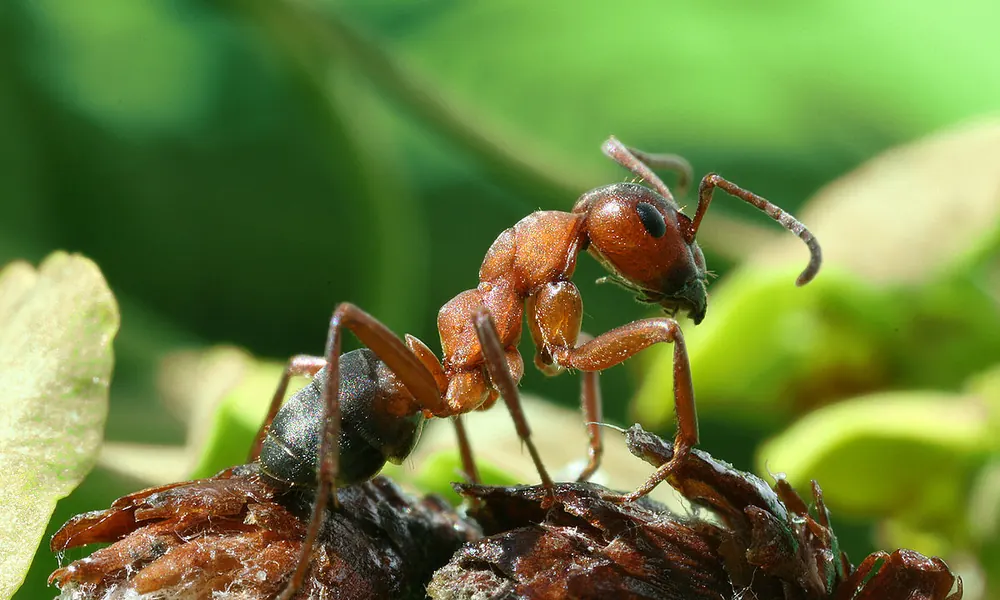
To get rid of ants for good in a Montana home, you need to deal with the nest, not the trail. That means using ant baits that the workers carry back to the colony, finding where they're getting in, and removing what's attracting them. Wiping or spraying the line in the kitchen kills the foragers you can see, and the nest just sends more.
Why ants are such a common complaint in Montana
A lot of Montana's housing is relatively new, with large areas of paving, brick driveways and patios laid on sand. Sand bedding under pavers is perfect for ant colonies. They nest beneath it, push up small heaps of fine sand between the bricks, and use the joints as highways to the house. As a building settles in its first few years, small cracks open along the base of walls, around door frames and where the patio meets the house. Ants find those gaps quickly.
The open veld nearby also holds large ant populations, and gardens laid on cleared grassland often inherit them. Irrigation lines, pipes and cables running into the house give ants an easy, hidden route indoors.
When ants come in
Ant activity indoors in Montana tends to jump in two situations. The first is just before and after summer thunderstorms, when rising moisture and flooded nests push colonies to move. The second is in dry spells, when ants come looking for water in kitchens, bathrooms and around pet bowls. Sweet foods, pet food, crumbs on counters and sticky bins draw them in. In complexes, ants often travel along the shared boundary walls and the narrow strips of garden between units, so a trail in your kitchen may well start in the neighbour's flowerbed. Electrical boxes, pool pumps and the irrigation controller in the garage are other spots where we regularly find colonies settling in, because they're warm and dry.
Flying ants or flying termites?
After the first big summer storm, you may see swarms of winged insects. Many people assume they're ants, but often they're termites. Ants have a narrow, pinched waist, elbowed antennae and front wings longer than the back ones. Termites have a thick waist, straight antennae and wings of equal length that break off easily. If you find piles of discarded wings indoors, check our page on termite control in Montana.
How we treat ants
- Trace the trail. We follow the ants back from where you've seen them to the entry point and, where possible, to the nest.
- Bait. We place ant baits along the trail and near entry points. Workers take the bait back and share it, which reaches the queen and the brood.
- Treat the outside. Where it's needed, we apply an odourless, non-staining barrier treatment along the foundations, door thresholds and paving edges.
- Advise on entry points. We'll point out the cracks, pipe entries and gaps worth sealing.
You don't need to leave the house. Keep children and pets away from treated areas until they're dry.
The common mistake
Spraying the trail with a household insecticide, or wiping it away with bleach, every time it appears. It feels like progress, but it kills the foragers and leaves the colony untouched. Some species respond by splitting into several smaller colonies, which makes the problem harder. If baits have been placed, leave the trail alone for a few days so the ants can carry the bait home.
A local tip
Look at the joints in your paving, especially where it meets the house wall. If you see small heaps of fine sand between the bricks, there's a colony underneath. Once it's been treated, re-sanding or sealing those joints along the base of the house closes off a lot of the ants' easy routes. Also keep pet bowls on a tray of water or move them off the floor at night.
What does ant control cost?
We price ant work on how many colonies we find, how large the property is and whether a perimeter treatment is needed on top of baiting. A single trail into one kitchen is a small job. Ants coming in at several points around a larger estate home takes more. If it's one small trail, a good ant bait from a supermarket may do the job, and we'll say so.
Ants often turn up alongside other crawling pests, and our crawling insect treatments in Montana cover the rest. For a citywide view, see ant control in Pretoria. We also deal with ants in Lynnwood homes, and you'll find everything else we treat on the Montana pest control page.
We're SAPCA registered, we've been working on Highveld ant problems for 25 years, and our treatments carry a 3-month guarantee: if the ants come back in that time, so do we. Call 012 012 5526, or WhatsApp us a photo of the ants and the trail.
Questions we get asked
Why are there sand heaps between my paving bricks?
That's ants nesting in the sand bedding under the paving. The heaps are the soil they've carried up out of the nest.
Will ant baits attract more ants at first?
Often, yes, for a day or two. That's a good sign. More workers are taking bait back to the nest.
Are flying ants after rain the same as termites?
Not always. Ants have pinched waists and elbowed antennae, while termites have straight bodies and equal-length wings.
Do ants damage the house?
Most house ants don't damage the structure, but they can get into electrical boxes and disturb paving. Termites are the ones that damage timber.
Why do ants come into the bathroom?
Usually for water, especially in dry spells. Leaking taps and damp shower recesses attract them.
Can I use ant powder from the shop?
For a small, single trail it can help, but powders kill foragers rather than the colony. Baits work better for a lasting fix.