
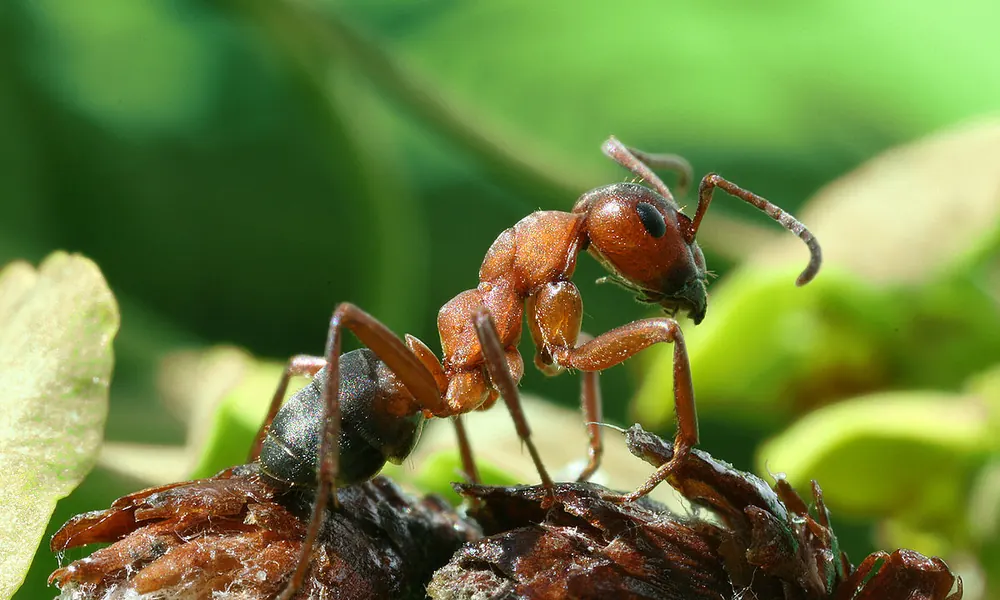
The ants on your counter are the small, visible end of a colony that might be living under a patio, in a tree trunk, behind a skirting board or in the cavity of an old wall. Killing the trail with a spray gives you a clean kitchen for a day. Getting rid of the colony means using a bait that the workers carry back to the nest, and that's what we do.
Why ants are so common on Waterkloof stands
Big established gardens hold enormous ant populations. Old paving, laid decades ago and lifted by tree roots, has gaps and voids underneath that ants love. Mature trees carry sap-sucking insects like aphids and scale, and many ants farm them for honeydew, so trails run up and down trunks and along branches that touch the house. Rockeries and dry-stone walls on the ridge give colonies dry, warm nesting sites.
Indoors, older homes have more cracks: along skirting boards, around window frames, at the joins between floors, and where newer sections meet the original house. Ants use every one.
When they come inside
Two moments bring most of our Waterkloof ant calls. The first is just before or after the first summer thunderstorms, when colonies are busy and nests flood. The second is during a long dry spell, when ants come indoors looking for water as well as food. Kitchens, sculleries, bathrooms and pet bowls are the usual targets.
Signs worth noting
- A steady trail along a skirting board, window sill or kitchen counter
- Fine soil or sand pushed up between paving bricks
- Trails running up tree trunks and onto the roof or gutter
- Ants clustering around the pet's food bowl or the sugar
- Small piles of debris near a crack in the wall
- Winged ants appearing indoors, which can also point to termites, so check before you treat
What we do
- Follow the trail. We trace it out of the house to where the colony actually lives.
- Bait, not just spray. We use ant baits the workers pick up and carry back to the nest, which reaches the queen and the brood. The bait type depends on whether the ants are after sugar or protein at that time.
- Treat nests and entry points. Where we can reach a nest under paving or at the base of a wall, we treat it directly, and use a barrier treatment at points where ants enter the house.
- Follow up where several colonies are involved, which is common on big stands.
On properties with a garden cottage or a pool house, we check those too. Ants often run a separate trail into each building from the same colony, and treating only the main house leaves the cottage kitchen as a constant source of new workers.
The mistake almost everyone makes
Spraying the trail, or wiping it with bleach, right after the bait goes down. The bait only works if the workers are allowed to keep feeding and carrying it home. For a few days, you'll see busy ants around the bait. That's the treatment working. Leave them to it.
A related mistake is treating ants indoors while the trail is running straight in from a tree branch resting on the gutter. Cut the branch back, or the next colony will simply walk in the same way.
A local tip
If you have old paving next to the house, brush fine sand into the joints after we've treated. Colonies shelter in the open gaps under lifted bricks, and filling them takes away a favourite nesting site close to your back door.
What does ant control cost?
It depends on how many colonies are involved, how big the property is, whether we need to treat paved areas and outbuildings, and whether a follow-up is needed. One trail into a kitchen is a fairly small job, and sometimes a good bait from a hardware store works fine for that. A large stand with several colonies coming in at different points needs a proper inspection and a plan.
Read more about species and seasons on our ant control page for Pretoria. Flying ants after rain can be termites, so if you're not sure, look at what termites look like in Waterkloof homes. Ants in the kitchen often come with cockroaches; Waterkloof cockroach treatments cover those. For the wider list of local pests, see pest control across Waterkloof, and our team also handles ant problems in Lynnwood.
One Stop Pest Control is SAPCA registered, and if the ants come back within three months of treatment, so do we. Call 012 012 5526 or WhatsApp us a picture of the trail.
Questions we get asked
Why do I see more ants after the bait goes down?
Because they're feeding on it. Workers gather at the bait and carry it back to the nest. Let them, and the trail should fade over the following days.
Are the ants on my trees harming them?
Usually not directly, but they protect aphids and scale insects that do weaken plants. Treating the ants can help the tree too.
Why are ants coming inside in winter?
In dry weather, ants search for water as well as food. Kitchens, bathrooms and pet water bowls draw them in.
Can ants damage my paving?
They can loosen it. Colonies nesting under paving remove sand from beneath the bricks, which can make them sink or lift over time.
How do I tell flying ants from flying termites?
Ants have a narrow waist and front wings longer than the back ones. Termites have a thick waist and four wings of equal length that drop off easily.