
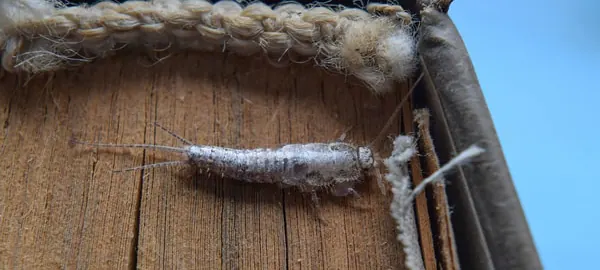
Silver, carrot-shaped insects that wriggle away when you open a cupboard, small irregular holes in wallpaper or book covers, yellowish marks on linen: that's fishmoth damage. Fishmoths (silverfish) are harmless to people, but in a house with valuable books, documents, artwork or stored fabrics they can do real harm over time. We find where they're breeding and treat those spots without staining anything.
What fishmoths are after
Fishmoths feed on starch, glue, cellulose and protein. In practice that means book bindings and the paste behind wallpaper, cardboard boxes, photographs, cotton and linen with starch in it, and even dust and crumbs in the back of cupboards. They hide by day in narrow, dark gaps and come out at night.
They also need moisture. They prefer air that's slightly humid and surfaces that stay cool, which is why they cluster near bathrooms, sculleries and laundries, behind skirting boards on outside walls and in cupboards built against a damp patch.
Why we see a lot of them in Waterkloof
It's the age and style of many houses. Built-in wooden cupboards that run floor to ceiling, panelled studies and libraries, old wallpaper, timber floors with gaps along the edges, and roof spaces holding years of stored boxes all provide food and shelter. Homes that have been in the same family for a long time often have a lot of stored paper, from old files to photo albums, sitting undisturbed. Diplomatic residences and offices may keep archives and documents on site as well.
A Highveld winter is dry, so fishmoths tend to concentrate in the few rooms that stay damp. Summer storms raise humidity and they spread out again.
Signs of a fishmoth problem
- Silvery insects in baths, basins and sinks in the morning
- Holes or scraped patches on book covers, spines and paper
- Irregular notches along the edges of wallpaper, especially near the skirting
- Yellow stains or small holes in stored linen and clothing
- Tiny pepper-like droppings and scales in drawers and shelves
How we treat fishmoths
- Find the harbourage. We check cupboards, shelving, skirting gaps, the roof space and stored boxes, and look for damp spots that are drawing them.
- Treat the hiding places. We apply an odourless, non-staining residual treatment into cracks, along skirting boards, at the back and base of cupboards and around stored items, rather than spraying across shelves and books.
- Treat the roof and storage areas where boxes are kept, since fishmoths there move down into the house.
- Advise on moisture and storage so they don't return.
You don't need to remove every book or empty every wardrobe. We'll tell you which cupboards to open up before we arrive, and you can carry on living in the house; just keep children and pets away until treated surfaces are dry.
What people get wrong
Mothballs and cedar blocks. They're traditional and smell reassuring, but they do very little to fishmoths, which simply avoid the immediate area and carry on feeding a shelf away. The other mistake is storing papers and photos in cardboard boxes in the roof. Cardboard is fishmoth food, and roof spaces in older homes are rarely sealed against insects.
A Waterkloof tip
Move anything valuable that's stored in cardboard into sealed plastic containers, and keep it off the floor of the garage or storeroom. If you have a library or a study full of books, take a few off each shelf now and then and look behind them. That's where fishmoths go first, and catching them there early saves the collection.
What does fishmoth control cost?
It depends on how many rooms are involved, how much shelving and built-in cupboard space needs treating and whether the roof and storage areas are part of the job. A few fishmoths in one bathroom may only need a damp problem fixed and a bit of cleaning. A house with heavy activity in cupboards, a library and stored archives is a bigger, more careful job, and we quote it after looking.
Background on fishmoths across the city is on our Pretoria fishmoth control page. Pantry insects sometimes turn up in the same cupboards; for weevils and moths, see stored product pests in Waterkloof. Our broader crawling insect control in Waterkloof covers the other night-time wanderers. For the full local picture visit pest control in Waterkloof, and we also treat fishmoths in Brooklyn's older homes.
We've been in pest control for 25 years and we're SAPCA registered. If fishmoths come back within three months of treatment, we come back too. Call 012 012 5526, or WhatsApp a photo of the damage to a book or cupboard.
Questions we get asked
Are fishmoths harmful to people?
No. They don't bite or carry disease. The problem is damage to books, paper, wallpaper, photographs and fabrics.
Will the treatment stain my books or cupboards?
No. We use a non-staining product applied into cracks and the backs of cupboards, not sprayed over books or clothing.
Why do I find fishmoths in the bath?
They come out at night looking for moisture and food, fall in and can't climb the smooth sides. It usually means there's harbourage nearby, often behind skirting or in a bathroom cupboard.
Do mothballs keep fishmoths away?
Not effectively. Fishmoths move a short distance away and keep feeding. Treating the harbourage and reducing damp works far better.
Can fishmoths damage old documents and photos?
Yes. They graze the surface and eat the glue and starch, which can ruin old papers and prints over time. Store them in sealed plastic, not cardboard.
Do fishmoths live in the roof?
They can, especially where boxes and papers are stored. From there they move into cupboards below, which is why we include storage areas in the treatment.