
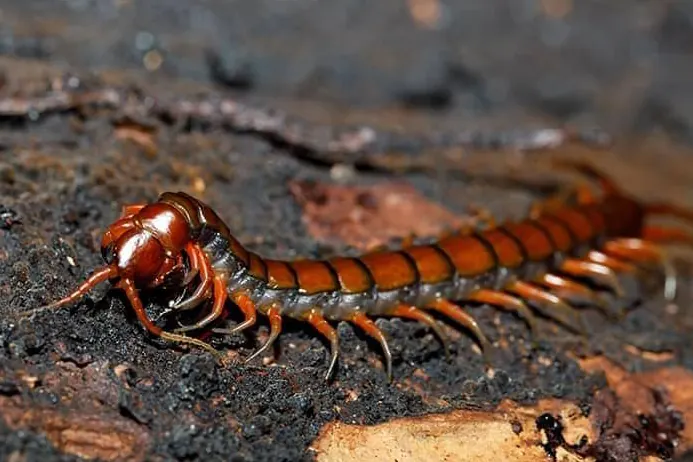
Centipedes are hunters. They come into houses following the insects they eat, and they stay where it's damp and dark. If you're seeing them regularly in a Waterkloof home, the fix is to find the moist harbourage they're using, deal with the insects feeding them, and treat the entry points and perimeter. Spraying the one on the wall solves nothing.
Which centipede is it?
Two kinds account for most calls. The first is the long-legged house centipede, a pale, very fast creature with long legs all around it, often seen on walls and ceilings at night. It's mostly harmless and actually eats cockroaches, fishmoths and spiders. The second is the large, flattened garden centipede (Scolopendra and its relatives), which can be several centimetres long, often orange, brown or dark green, and gives a painful bite. These usually live outside under rocks, logs and mulch, and wander in after rain or in hot weather.
It's easy to confuse them with millipedes. Centipedes are flat, quick and have one pair of legs per body segment. Millipedes are rounded, slow and curl up when touched.
Why Waterkloof homes get them
Centipedes need moisture and shelter. Waterkloof gardens provide both in quantity: deep mulch beds, leaf litter under mature trees, compost heaps, damp corners shaded by hedges, potted plants on stoeps and loose stones on the ridge. Older houses add damp spots of their own, such as bathrooms with old grouting, laundry rooms, cellars or storerooms with poor ventilation, and gaps under wooden doors.
The insects they eat are the other half of the picture. A house with cockroaches, fishmoths or crickets will draw centipedes in after them.
Where they show up
- Baths, showers and basins, usually first thing in the morning
- Laundries, sculleries and staff bathrooms
- Cellars, storerooms and under-stair cupboards
- Garages, especially under stored boxes or along the walls
- Ground-floor rooms near the garden, after heavy rain
Our approach
- Inspection. We look for damp areas, leaks, harbourage in the garden close to the walls, and gaps where they enter.
- Perimeter and entry-point treatment. We apply an odourless, non-staining residual treatment around the foundations, doorways, airbricks, drains and garage entrances.
- Indoor treatment of damp harbourage, such as storeroom edges, under-sink cupboards and laundry corners.
- Dealing with the food. If cockroaches or fishmoths are feeding them, we treat those too.
- Advice on moisture and garden layout.
Seasons matter
Centipede sightings in Waterkloof follow the weather. They rise sharply with the first summer storms, when soil and leaf litter become saturated and the hunters move to drier ground, and again during hot spells when they come in looking for cool, moist spots. In the middle of a dry Highveld winter you'll rarely see them, except in rooms that stay damp. If yours appear all year round, that's a strong hint that somewhere inside the house is staying wet, and finding that spot is worth more than any spray.
What people get wrong
Treating the centipedes and ignoring the damp. If the laundry floor stays wet, the cellar has no airflow or the mulch is piled against the house, centipedes will keep coming back. The other mistake is picking up a large garden centipede. Their bite is very painful and can cause swelling. Use a container or a broom.
A Waterkloof tip
Rake mulch and leaf litter back from the walls so there's a strip of dry ground, at least a hand's width, all round the house. On stands with large trees, leaves pile up against walls quickly, and that damp layer is exactly where centipedes sit waiting for prey.
What does centipede control cost?
The price depends on the size of the house and perimeter, the number of outbuildings, whether there are other insects that need treating and how much indoor treatment is needed. One house centipede on the ceiling now and then doesn't need treatment at all; it's doing you a favour. Regular large garden centipedes indoors, particularly in a home with young children, are worth sorting out properly.
Our centipede control across Pretoria page explains species in more detail. Centipedes often follow other insects in, so if you're seeing cockroaches in your Waterkloof kitchen, deal with those too. The slow, curled-up creatures after rain are probably millipedes; see millipede control in Waterkloof. For the full local list, visit our Waterkloof pest control page. We also treat centipedes in Brooklyn homes.
SAPCA registered, 25 years in the trade, and if they come back into the house within three months, we come back too. Call 012 012 5526 or WhatsApp us a photo so we can tell what you've got.
Questions we get asked
Are centipedes dangerous?
House centipedes are mostly harmless. Large garden centipedes can give a painful bite that swells, so don't handle them, especially around children.
Why are centipedes in my bath?
They come in looking for moisture and prey at night, slip into the bath and can't climb out. It usually means there's damp harbourage nearby.
What's the difference between a centipede and a millipede?
Centipedes are flat, fast hunters with one pair of legs per segment. Millipedes are round, slow plant-eaters with two pairs per segment and curl up when disturbed.
Do centipedes mean I have other pests?
Often. They feed on cockroaches, fishmoths, spiders and crickets, so a steady supply of centipedes indoors suggests there's prey for them.
Will fixing damp really reduce centipedes?
Yes. Centipedes dry out quickly, so damp areas are essential to them. Removing moisture makes a house much less attractive.