
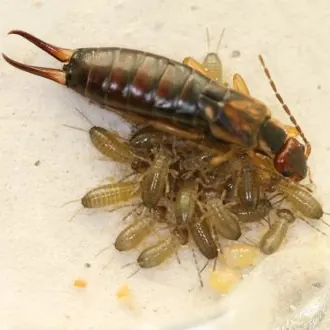
Crawling insects are anything that walks rather than flies into your house: cockroaches, ants, fishmoths, crickets, beetles, earwigs, millipedes and centipedes. In a Waterkloof home, most of them are coming in from the garden or up through the plumbing, so the most effective treatment combines a perimeter barrier with targeted work on the places they hide indoors.
Two kinds of crawling problem
It helps to divide them into two groups.
The ones that live indoors. German cockroaches, fishmoths and pantry beetles complete their whole life cycle inside the house. Treating the perimeter won't touch them. They need treatment where they hide: kitchen units, built-in cupboards, bookshelves and pantry shelves.
The ones that come in from outside. American cockroaches, ants, crickets, beetles, earwigs, millipedes and centipedes live in the garden, drains and outbuildings and wander in. For these, sealing entry points and treating the line they cross does most of the work.
Many homes have both, which is why we inspect before deciding what to do.
How Waterkloof properties let them in
Older houses have had decades to develop gaps. Wooden doors shrink and leave space underneath, old sliding doors don't seal at the base, airbricks lose their mesh, and pipes running through walls leave holes around them. Paving laid long ago has lifted and opened up, giving ants and other insects sheltered tunnels right to the walls. Floor drains in sculleries, laundries and staff bathrooms dry out in winter and open a path from the sewer.
The gardens supply the numbers. Deep mulch, leaf litter from big trees, compost, rockeries and dense ground cover against the walls all hold large populations of crawling insects within a short walk of your back door.
Our approach
- Inspection. We identify which insects are coming in and where, and look for harbourage inside and out.
- Indoor targeted treatment. Gel baits for cockroaches, ant baits where ants are trailing, and a non-staining residual treatment into cracks, cupboards and skirting where fishmoths and beetles hide.
- Perimeter barrier. An odourless residual treatment along foundations, doorways, airbricks, drains and garage entrances.
- Proofing and garden advice. Door seals, drain maintenance, pulling mulch back from walls and fixing damp.
- Follow-up where cockroaches or several ant colonies are involved.
You can stay in the house during treatment; just keep pets and children off treated areas until they're dry.
What people often get wrong
Relying on a perimeter spray to fix an indoor problem. If German cockroaches are living inside the dishwasher motor, the barrier outside will make no difference. The reverse is true too: gel baiting the kitchen won't stop crickets and millipedes walking in under the garage door. Matching the treatment to where each insect actually lives is the whole skill of the job.
A local tip
Check the base of every external door with a torch at night from inside, with the lights off outside. If you can see light from the outside lamp under a door, insects can get through. On older Waterkloof homes, fitting brush strips or rubber seals to a handful of doors cuts down a remarkable amount of crawling traffic.
Older homes with timber floors often have gaps along the edges of the boards, and we treat those along with the skirting.
A seasonal note
The first heavy summer rains trigger a rush of crawlers indoors as soil and leaf litter flood: millipedes, crickets, beetles and centipedes particularly. Dry winters bring ants in search of water, and leave drain traps dry so American cockroaches come up. A perimeter treatment timed before the rains and a habit of wetting drains through winter covers both peaks.
What does it cost?
It depends on the size of the house and the perimeter, which insects are involved, how many outbuildings need treating and whether follow-ups are required. A perimeter treatment for a few crickets and beetles is relatively simple. A combined indoor and outdoor treatment on a large stand with a cottage and staff quarters takes longer. If you're only seeing the odd beetle after rain, a door seal may be all you need.
Our crawling insect control for Pretoria page has more detail on each group. For the big two, see dealing with cockroaches in Waterkloof and Waterkloof ant control. The pest control in Waterkloof overview covers the rest, and we also treat crawlers in older homes through crawling insect control in Brooklyn.
We're SAPCA registered, have 25 years of experience and guarantee our treatments for three months. Call 012 012 5526, or WhatsApp a photo of what's crawling in.
Questions we get asked
Which crawling insects are the most important to treat?
Cockroaches, because they contaminate food and surfaces, and ants that invade kitchens. Others, like crickets and millipedes, are mostly a nuisance.
Will a perimeter spray keep out cockroaches?
It helps with American cockroaches coming in from outside, but German cockroaches live indoors and need gel baiting where they hide.
Why do I see more beetles and crickets after rain?
Heavy rain floods their habitat in the soil and leaf litter, so they move toward higher, drier ground, which is often the house.
Do earwigs damage anything?
Mostly no. They can nibble soft plants and seedlings in the garden, but indoors they're a nuisance rather than a threat.
How long does a perimeter treatment last?
It keeps working for weeks, but heavy rain, irrigation and garden work wear it down over time. Our treatments carry a 3-month guarantee.
Can you treat outbuildings at the same time?
Yes. Garages, cottages and pool houses are often where crawlers gather first, so we include them in the plan.