
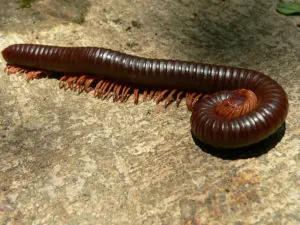
Millipedes don't bite, sting or damage your house. So why call anyone? Because after a good Highveld summer storm they can come out in their hundreds, climb the walls, crawl under doors, die in corners and leave a smell and brown stains where they've been squashed. If that's happening at your place, a perimeter treatment plus a few changes to the garden beds against the house will get it under control. We've been doing exactly this for Pretoria and Centurion homes for 25 years.
Shongololos: what's actually going on
Millipedes, or shongololos, live in damp soil, compost, mulch and leaf litter, where they eat decaying plant material. That makes them useful in the garden, and a few of them are nothing to worry about. The trouble starts when conditions let their numbers build up close to the house, and then something pushes them to move.
That something is usually rain. In a dry winter they stay deep in the soil and you hardly see them. When the summer rains arrive, the soil softens, food is plentiful and they become active. After heavy downpours, saturated soil drives them up and out, and many head for the nearest raised, sheltered surface: your walls, your patio and the gap under your kitchen door. Once inside, they usually dry out and die within a few days, which is why people find them curled up dead along skirting boards.
Is it a millipede or a centipede?
Millipedes are round, slow and have two pairs of legs on each body segment. They curl into a tight spiral when you touch them. Centipedes are flat, fast and have one pair of legs per segment, and the big ones can bite. If yours are flat and quick, have a look at our Pretoria centipede control instead, because the approach is different.
What draws millipedes to your house
- Thick mulch, bark chips or compost right up against the walls
- Irrigation that keeps the foundations wet every evening
- Dense ground cover and leaf litter under mature trees
- Gutters overflowing onto the same patch of soil
- Gaps under doors, unsealed air bricks and cracks where the paving meets the wall
- Outside lights near doors, which some millipedes are drawn to at night
The older suburbs with big trees and established beds, and newer estates where developers laid generous mulch along every wall, are where we see the biggest outbreaks.
Our approach
First, we look at why your property is producing so many. That means checking the beds along the walls, the irrigation, the gutters and the soil levels against the house. Often the source is one or two particular beds, and fixing those matters more than any treatment.
Then we apply a residual barrier treatment around the foundations, along the base of walls, across door thresholds and over the edge of paving and patios. It's odourless and doesn't stain, so it won't mark painted walls or paving. The treatment stops millipedes that are moving towards the house, and inside we treat the edges where they're getting in. You can stay at home; just keep kids and pets off treated surfaces until they're dry.
During a heavy season we may suggest a repeat treatment, because a big population in the garden can keep pushing for weeks after the rains start.
What people get wrong
The usual instinct is to spray the millipedes you can see, sweep them up and wait for the next lot. That deals with the symptom. As long as the damp, mulch-heavy strip along the wall stays, it keeps producing more. The other mistake is squashing them on paving and tiles; their body fluids can leave stubborn stains. Sweep them into a dustpan instead.
A local tip for summer
Before the rainy season starts, rake back mulch and bark chips to leave a dry, bare or gravel strip along the walls of the house, and adjust sprayers so they water the garden, not the foundations. On the Highveld, where most of our rain comes in short, heavy afternoon storms, that dry strip is often the single biggest thing you can do. Millipedes don't like crossing dry ground.
Prevention checklist
- Keep mulch and soil below the damp-proof course and away from the walls.
- Clean gutters so they don't overflow onto the beds.
- Fit brush strips or seals under outside doors, especially sliding doors.
- Clear heavy leaf litter from paving and beds near the house.
- Store firewood, pots and bags of compost away from the walls.
What does millipede control cost?
It's priced mostly on the size of the perimeter and garden we're treating. A typical house is a single visit. A large property with long walls, outbuildings and extensive beds takes longer, and a bad season may need a second visit. If you're finding a handful after a storm, the garden changes above may be enough on their own, and we'd rather tell you that than sell you a treatment.
Homes, complexes and estates
In complexes, millipedes often build up in shared garden areas and move into ground-floor units. Treating the whole block's perimeter through the body corporate works much better than one unit at a time. For estates, we can treat around clubhouses, schools and common buildings as well. We see a lot of shongololo activity in Moreleta Park homes and around Montana's newer estates. If millipedes are only part of what's crawling in, our crawling insect treatments cover the rest.
We're SAPCA registered, and if the millipedes come back within three months of treatment, our guarantee means we come back too. Call 012 012 5526 or WhatsApp us a photo of what you're seeing.
Questions we get asked
Are millipedes harmful?
No. They don't bite or sting and don't damage the house. Some release a defensive fluid that can irritate skin or stain surfaces, so sweep them up rather than handling or squashing them.
Why are there suddenly so many millipedes after rain?
Heavy rain saturates the soil they live in, so they move up and out, often onto walls and into houses. Summer storms on the Highveld trigger this regularly.
Why do I keep finding dead millipedes inside?
Millipedes need moisture. Indoors they dry out quickly and die, often along skirting boards and in corners.
Will removing mulch really help?
Yes. A damp mulch strip against the walls is where most of the millipedes near your house live and breed. Moving it back and keeping that strip dry makes a big difference.
Can millipedes damage my plants?
Usually very little. They mostly eat rotting plant matter, though in large numbers they may nibble seedlings and soft fruit lying on damp soil.
Does the treatment harm birds or garden life?
The treatment is applied to a narrow band around the house, not sprayed across the whole garden, which keeps the effect on the rest of the garden low.