
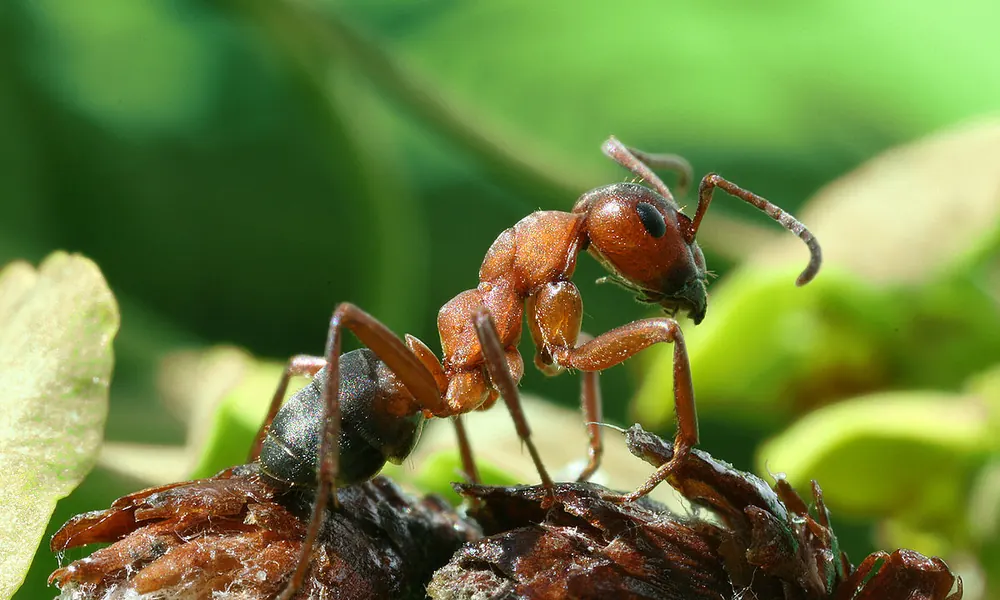
Ants in a Lynnwood house come from a nest you usually can't see, often in the garden, under paving or inside a wall. The reliable way to stop them is with ant bait that workers carry home and share, so the queen and the brood are dealt with, combined with a barrier treatment where they come in. Spraying the trail only kills the ones on duty that day.
Why Lynnwood has so many ants
Ants need three things: a sheltered nest site, moisture and a steady food supply. Lynnwood's mature gardens supply all three. Big trees harbour aphids and scale insects, which produce the sugary honeydew many ants farm. Thick beds, old paving and retaining walls give nest sites. Irrigation keeps the soil damp. And from the garden, ants have a choice of routes inside: tree branches against the gutters, creepers on the walls, paving that runs right up to the kitchen door, and gaps where pipes and cables enter.
Activity jumps in spring and just before summer thunderstorms, when ants move nests or look for higher, drier ground. A trail that appears from nowhere on a humid afternoon is often a nest relocating ahead of rain.
The ants you're likely to meet
- Small brown house ants that form long trails to sugar, honey, pet food and fruit bowls.
- Big-headed ants, with workers of two sizes, which push up little piles of sand between paving bricks and along skirting boards.
- Pugnacious ants, larger black ants that bite when disturbed and nest in lawns and under stones.
- Ants nesting in walls and plug points, which leave tiny heaps of grit or dust at cracks and electrical fittings.
Our approach to ants
First we follow the trails, inside and out, to find where they nest and how they get in. Then we place ant bait along active trails and near nest openings. Workers feed on it and carry it back, and it moves through the colony over the following days. You'll often see more ants at first, all feeding, which is a good sign. Outside, we treat entry points, paving joints and the base of walls with an odourless, non-staining residual product. Where ants are in a wall void or plug point, we treat that void directly. If a big colony is involved, we come back for a follow-up.
Where people go wrong
Wiping up the trail with spray or bleach every morning. It kills a few hundred workers, the nest replaces them overnight, and the scent trail simply shifts. Spraying over bait is worse: it stops the ants feeding on it. If we've baited, leave the trails alone for a few days, however tempting it is to clean them up.
Another common mix-up is with termites. Winged ants and winged termites both appear after rain. Ants have a narrow waist and elbowed antennae; termites have a thick, straight body. If you're seeing termites coming out of a wall or floor, our page on termite inspections in Lynnwood explains what to do next.
A local tip: look up, not down
In Lynnwood, a surprising number of indoor ant problems start in a tree. If ants are coming in at window height or from the ceiling, go outside and check for branches touching the roof or gutters, and look at the trunk. A trail running up a tree usually means ants farming aphids or scale in the canopy, and those branches lead straight to your roofline. Trim them back, deal with the sap-sucking insects on the tree, and the indoor trail often dries up with it.
What does it cost?
It depends on how many nests are involved, whether ants are inside walls or electrical fittings, the size of the property and whether a follow-up is needed. One trail to the kitchen from a single garden nest is a small job, and sometimes a good bait from a hardware store, placed on the trail and left alone, will do it. Ants inside the walls in several rooms, or a large property with heavy activity across the garden, takes more work.
For ant control in other parts of the city, see our Pretoria ant control page. We also treat ants in the homes and complexes next to the nature reserve through ant control in Faerie Glen. For a gentler, targeted approach to pest control in general, read about eco-friendly pest control in Pretoria, and for the rest of the local pests, visit Lynnwood pest control.
We've been treating ants for 25 years and we're SAPCA registered. If the ants return within three months of our treatment, we'll come back and sort it. Call 012 012 5526, or send us a photo on WhatsApp of the ants or the trail.
Questions we get asked
Why are there more ants after the bait was put down?
Because they've found the bait and are recruiting others to feed. It's a good sign that the bait is being carried back to the nest.
Why do ants come inside before it rains?
Many ants move their nests or look for drier ground ahead of a storm, and a house offers both shelter and food.
Are the ants in my plug point dangerous?
They can damage electrical fittings over time, so it's worth treating. Don't spray liquid into a plug point; let us treat the void properly.
Do ants in the garden need to be treated?
Usually not. Most garden ants help the soil. We treat nests that are sending ants indoors, biting people or causing problems in paving.
Can I stay home while you treat for ants?
Yes. Keep children and pets off treated areas until they're dry, and leave the bait undisturbed.