
If you have rats or mice in Moreleta Park, the job is to find out where they're living, bait them safely in lockable stations, and close the gaps they're using. How that plays out depends heavily on what kind of home you're in, because the suburb has three quite different types of property and rodents exploit each one differently.
Freestanding houses
The older homes that make up much of the suburb tend to have mature gardens, big trees, compost heaps, dog food bowls on the stoep and a garage full of stored things. That gives rodents cover, food and somewhere warm to nest. The usual entry points are a gap where the fascia board has pulled away, a tree branch resting on the roof, an air brick with a broken grille, or a garage door that no longer seals at the bottom.
Roof rats are the common culprits upstairs. Mice tend to set up in the garage, the pantry or behind kitchen units.
Townhouse complexes
In a complex, rodents treat a row of units as one building. They run along shared roof voids, wall cavities and service ducts, and the bins at the refuse area feed the lot. Treating one unit pushes the problem next door for a while, and then it comes back. The approach that works is a plan for the whole complex: bait stations around the perimeter and the refuse area, traps in the roof spaces where activity is heavy, and proofing done consistently across the units.
Estates on the edge of the suburb
Newer estates near open ground get rodents moving in from outside, especially when the veld dries out and the nights get cold. Here the boundary is the front line. Stations placed along the perimeter wall intercept rodents before they reach the houses.
Rat or mouse? It changes the plan
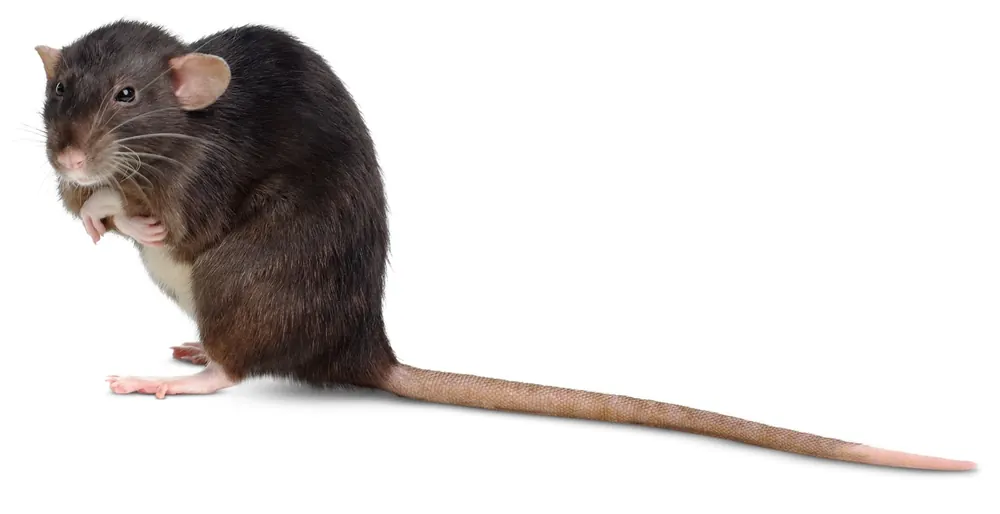
Rat droppings are about the size of a raisin; mouse droppings are closer to a grain of rice. Rats are cautious and avoid new objects for a few days, so baiting takes patience. Mice are curious and nibble at everything, but they range only a few metres from the nest, so placement has to be tight. For a closer look at each one, see our pages on rats in Moreleta Park and getting rid of mice locally.
Our process
- Inspection. Roof void, garage, kitchen, outbuildings and garden, looking for droppings, rub marks, gnawing and nests.
- Baiting and trapping. Tamper-resistant, lockable stations go where rodents travel and where pets and children can't reach them. Traps go in roofs and indoor spaces where poisoned rodents dying out of reach would be a problem. Tracking powder can be used in wall voids and ducts where it suits.
- Proofing advice. We show you exactly which gaps to close, and with what.
- Follow-up. We check stations and adjust until activity stops.
What most people get wrong
Scattering loose bait in the roof is the classic mistake. Rodents carry it into the walls, some die where you can't get at them, and the hole they came in through is still open. Another one is stopping as soon as the noise does. The first rodents die off, the gap stays open, and the next lot moves in a month later.
Prevention, with a local twist
- Keep pet food indoors at night and pick up fallen fruit from the lawn.
- Cut back branches and creepers so nothing touches the roof.
- Fit a brush strip or rubber seal to the bottom of the garage door.
- Move wood piles and building rubble off the boundary wall.
In Moreleta Park, plenty of homes keep a vegetable patch or compost bin behind the garage. That's fine, but keep the compost in a closed bin and well away from the house wall, because it's one of the first places brown rats dig in.
What does it cost?
For a house, it depends on the number of stations, whether we need to work in the roof and how many visits it takes. For a complex or estate, we quote based on the number of units, the perimeter and whether you want an ongoing monitoring contract. If you've seen a single mouse once, try a couple of snap traps first. We'd rather tell you that than sell you a treatment you don't need.
Before winter arrives, it's worth reading our guide to preparing for rats and mice. For the full city-wide view, see rodent control in Pretoria, or browse our Moreleta Park pest services. We're also busy with rodent work in neighbouring Garsfontein.
All rodent treatments come with our 3-month guarantee, backed by 25 years of work and SAPCA registration. Call 012 012 5526 to arrange an inspection, or WhatsApp a photo of the droppings and we'll identify them.
Questions we get asked
How do I know whether I have rats or mice?
Look at the droppings. Rat droppings are about raisin-sized and blunt, while mouse droppings are small and pointed, roughly the size of a grain of rice.
Why do rodents keep coming back to our complex?
Because units share roof voids and walls. Unless the whole complex is treated and proofed, rodents move between units and reinfest treated ones.
Are bait stations safe around my children and dogs?
Yes, when they're lockable and tamper-resistant. The bait sits inside a box that kids and pets can't open, and we place stations out of their way.
Do you use traps or poison?
Both, chosen for the spot. Stations outside and in protected areas, traps in roof spaces and living areas where a rodent dying out of reach would be a problem.
When do rodent problems usually start in Moreleta Park?
Most calls start in late autumn, when cold nights push rats and mice indoors, and carry on through winter.
Can you set up regular rodent monitoring for our estate?
Yes. Estates, schools and businesses can have scheduled visits where each station is checked and recorded.