
Spiders don't usually need a big treatment. What they need is a sensible plan: identify which spiders you're seeing, deal with the few that are a real concern, and reduce the insects that are feeding them. When numbers are high, or a spider that bites is living somewhere children play, we treat the hiding places and the outside of the house with a targeted, odourless residual product.
The spiders we get asked about here
Rain spiders
Large, brown and fast, rain spiders are the ones that appear on the wall before or after a summer storm and give the family a fright. They're huntsman spiders, not web builders. They are not considered dangerous to people, although a frightened one can bite. Females guard large egg sacs, often in shrubs or under eaves, and when those hatch you may suddenly see dozens of tiny spiders.
Button spiders
These small, round-bodied spiders build untidy webs in sheltered, dry spots: under garden furniture, inside the water meter box, behind pot plants, in the corners of a wendy house or a stack of bricks. Black button spiders have a neurotoxic venom and a bite needs medical attention. Brown button spiders are more common around homes and their bites are generally milder, but it's still worth keeping them away from where children play.
Sac spiders
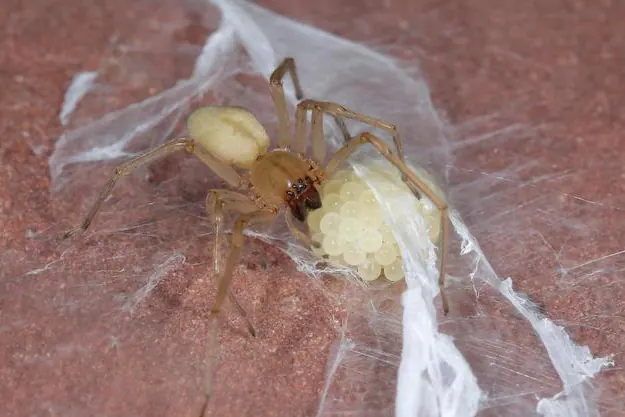
Small, pale, yellowish spiders that wander indoors at night and shelter in folded curtains, clothing and corners during the day. They're among the more common causes of spider bites in homes. Bites can sometimes turn into slow-healing sores, so anyone with a worsening bite should see a doctor.
Garden web builders
Orb weavers and other web spinners string webs across paths and between shrubs in summer. They're harmless, and a nuisance only when they keep covering the patio and the security beams.
Why Moreleta Park gardens attract spiders
The suburb's established gardens have everything spiders like: shrubs, creepers, rockeries, outbuildings, stacked pots and plenty of insects. Outside lights near the front door and patio attract moths and flying insects at night, and spiders set up around those lights to feed on them. Homes in the newer estates near open ground also get spiders moving in from the veld.
How we approach spider control
- Identification. We look at what you're seeing and where. That tells us whether this is a nuisance or a risk.
- Targeted treatment. We treat eaves, window frames, outside light fittings, garden furniture, sheds, wendy houses, rockeries and other hiding places with an odourless, non-staining residual product.
- Indoors where needed. Corners, behind furniture, under beds and in garages are treated if sac spiders or other indoor species are a problem.
- Insect reduction. Fewer insects means fewer spiders. We'll suggest changes to lighting and garden clutter that help.
What people get wrong
Spraying every web you see with a household aerosol. It kills a spider here and there but doesn't touch the egg sacs, the sheltering spots or the insects the spiders are feeding on. People also often panic about rain spiders, which, while alarming to look at, are not the ones to worry about. Button spiders in a dark corner of the play area are much more worth your attention.
Prevention
- Switch outside lights off when you don't need them, or use yellow bulbs that attract fewer insects.
- Shake out shoes, gloves and garden cushions that have been left outside.
- Keep stacks of bricks, pots and timber away from the house and play areas.
- Wear gloves when clearing out the shed, the water meter box or the pool pump housing.
Local tip: in many Moreleta Park homes, the pool pump cover and the meter box at the front wall are favourite button spider spots. Check them carefully, with a torch and gloves, before you put a hand in.
What does it cost?
A spider treatment for a typical house and garden is a straightforward job. Costs go up with the size of the property, the number of outbuildings and whether indoor treatment is needed as well. For a few rain spiders or harmless garden webs, you probably don't need us; a broom and tolerance work well. If you're seeing button spiders in play areas or sac spiders indoors, a treatment makes sense.
Spiders and scorpions often hide in the same rockeries and wood piles. See scorpions in Moreleta Park if you're seeing both. For our wider spider service, try spider control across Pretoria. Other local pests are on our Moreleta Park page, and we cover spider treatments in Faerie Glen next door.
If treated spiders come back within three months, we return at no extra charge. Call 012 012 5526, or WhatsApp us a photo and we'll tell you whether you need to worry.
Questions we get asked
Are rain spiders dangerous?
They aren't considered dangerous to people. They're large and fast, which makes them alarming, but they're far less of a concern than button spiders.
Which spiders in Pretoria East should I be careful of?
Button spiders and sac spiders are the main ones. Black button spider bites need medical attention, and sac spider bites can become slow-healing sores.
Why are there so many spiders around my outside lights?
Lights attract moths and flying insects at night, and spiders gather where the food is. Reducing outside lighting helps.
Will a spider treatment kill the egg sacs?
A residual treatment around hiding places affects spiderlings as they hatch and move across treated surfaces. We also remove sacs we find.
Do I need to leave the house during a spider treatment?
No. Just keep children and pets off treated surfaces until they're dry.
What should I do if someone is bitten by a spider?
Clean the bite and seek medical advice, especially if the bite worsens, the person feels unwell, or you suspect a button spider.