
Spider control works when it's targeted: treating the places spiders shelter and the insects they feed on, rather than spraying the whole property. In Faerie Glen, homes near the reserve and on the rocky ridges tend to see more spiders, because the grassland and stone provide endless shelter and the insects they hunt. Most are harmless, but it helps to know which ones aren't.
The spiders Faerie Glen residents ask about
Rain spiders
Large, flat, hairy brown spiders that appear on walls and ceilings, often just before or after summer storms. They're alarming to look at, especially at night, but they're not considered dangerous to people. They hunt insects and usually move on.
Button spiders
The black button spider, with its shiny black body and often a red mark, and the brown button spider are the ones to be careful of. They build untidy webs in sheltered, undisturbed spots: under garden furniture, in pot plants, inside pool equipment, around stacked bricks and in garage corners. The brown species is more common around houses. A bite from a black button spider needs medical attention.
Sac spiders
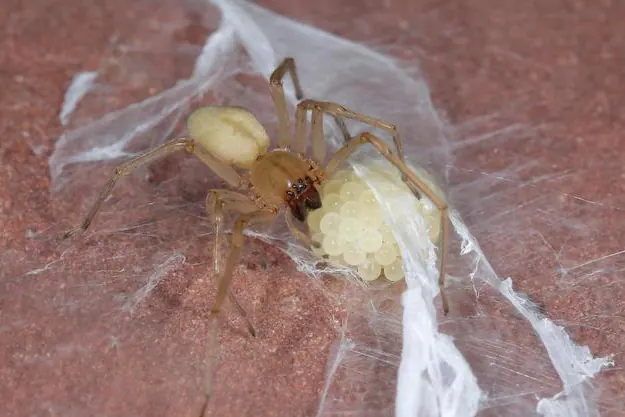
Small, pale spiders that hunt at night indoors and hide in a silk sac during the day, often in curtain folds, behind picture frames or in the corner where wall meets ceiling. People sometimes wake up with a bite they blame on a sac spider.
Garden orb weavers
The big webs strung between trees and across paths in late summer. Harmless, and good at catching flying insects.
Why the ridges and reserve matter
Spiders follow food and shelter. The open grassland supports huge numbers of insects in summer, and the rocky ridges, stone walls, rockeries and retaining walls common in this part of Pretoria East give spiders a protected place to live. Outdoor lights near the house draw insects in at night, and the spiders follow them to the eaves and window frames. A house that backs onto open ground, has a stone retaining wall and leaves the patio light on all night is, from a spider's point of view, ideal.
How we treat spiders
- We inspect the house and garden to find where spiders are concentrated, and which types they are.
- We treat eaves, window frames, garage corners, outbuildings and garden structures with odourless, non-staining residual products.
- We remove and treat webs and egg sacs where button spiders are present, particularly around play areas and entertainment spaces.
- Where spiders are thriving because of a big insect population, we look at that too, because cutting the food supply is what makes the result last.
There's no need to leave the house. Children and pets should stay off treated surfaces until they're dry.
Spiders in complexes
Townhouse complexes in Faerie Glen often have communal gardens, garages in a row and boundary walls shared with open ground. Spiders don't stop at a unit boundary, so a body corporate treatment of garages, eaves and common garden structures usually gives better results than individual owners treating their own patch. It also means play areas and pool surrounds get the attention they need.
The mistake to avoid
Spraying every spider on sight and ignoring why they're there. If the insects keep coming, so do the spiders. And while it's tempting to want every spider gone, killing the harmless ones that eat mosquitoes and flies isn't always in your interest. A good treatment focuses on living areas, entrances and the places you and your children actually touch.
A tip for homes on rocky ground
Before you reach into a pile of bricks, a stack of pots or a pool pump box, give it a knock with a stick and wear gloves. Button spiders and scorpions use the same kind of hiding place, and our page on scorpions in Faerie Glen gardens covers the other half of that risk.
What does it cost?
Price is mostly about scale: the size of the house and garden, how many outbuildings there are and how much rockery or stonework needs attention. A general spider treatment of the house exterior and eaves is fairly straightforward. A large property backing onto the reserve with stone walls, a pool area and outbuildings takes longer. If you're seeing the odd rain spider after a storm, that's normal and you may not need us at all.
For more detail, see spider control across Pretoria, or our Garsfontein spider treatments if you're a little further west. Everything else we deal with around the reserve is on our Faerie Glen pest control page.
As a SAPCA-registered company, we stand behind the work for three months: if the spiders return in that time, so do we. Call 012 012 5526, or WhatsApp a photo of the spider and we'll help identify it.
Questions we get asked
Are rain spiders dangerous?
No, they're not considered dangerous to people. They're big and fast, which is frightening, but they eat insects and generally leave you alone.
How do I recognise a button spider?
Look for a shiny, round-bodied spider in a messy web in a sheltered spot. Black ones often have a red mark. Brown ones have a patterned, mottled body and spiky round egg sacs.
What should I do if I'm bitten by a black button spider?
Go to a doctor or hospital immediately. Try to take the spider with you, or a photo of it, to help with identification.
Why do I get so many spiders after rain?
Storms flush spiders out of the ground and from under rocks, and rain spiders in particular come indoors looking for a dry place.
Will a treatment kill the spiders in my garden too?
We focus on the house, eaves, outbuildings and areas you use. We don't blanket-spray the garden, because many garden spiders are harmless and useful.
Do spider treatments smell?
No. We use odourless, non-staining products, so you won't be left with a smell in the house.